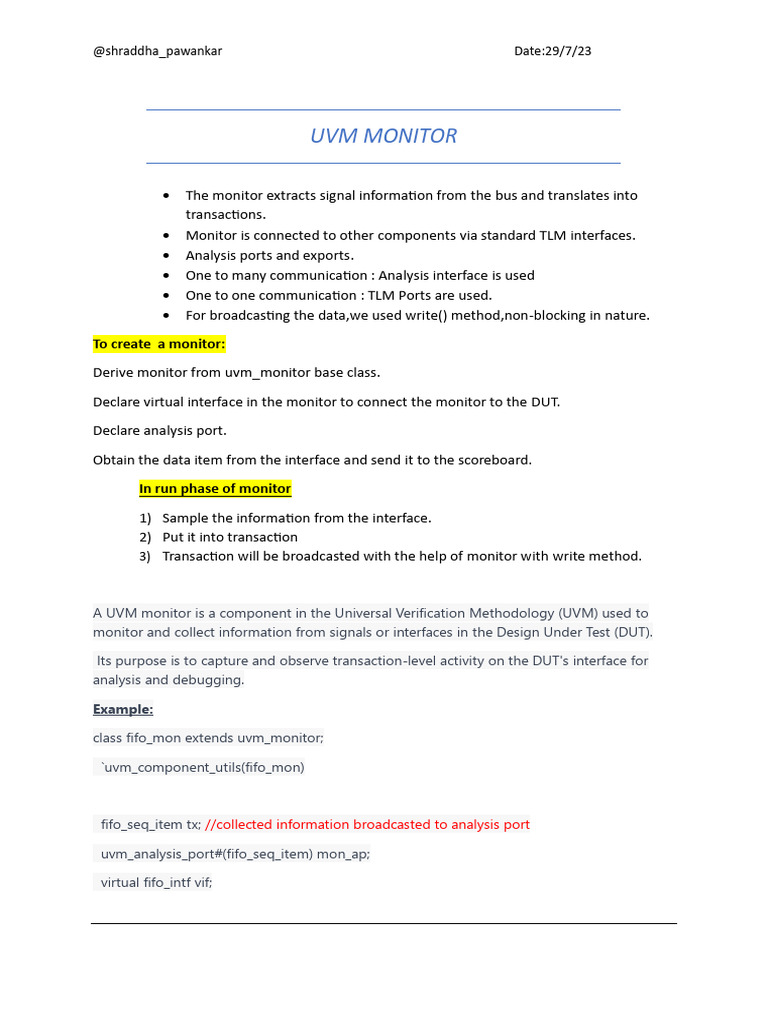
In the expansive realm of digital design, the Universal Verification Methodology (UVM) stands as a veritable colossus, offering a comprehensive framework for systematic verification of integrated circuit designs. Among its myriad components and functionalities, the monitor plays a pivotal role that warrants in-depth exploration. This article delves into what the monitor does within UVM, addressing common observations while hinting at the fascinating complexities that underpin its functionality.
The monitor in UVM is often seen merely as a passive observer, tasked with collecting data and reporting findings. However, this simplistic view belies the deeper intricacies of its operation and its critical importance in the verification process. At its core, a monitor is designed to respond to stimuli within the environment it supervises, gathering information without actively interfering in the transactions taking place. This non-intrusive nature makes it indispensable in ensuring that the design-under-test (DUT) operates according to specified protocols.
The Fundamental Purpose of the Monitor
Essentially, the monitor functions as a sophisticated data collection unit. By observing the interface signals of the DUT, it captures transactions and gathers pertinent data. This data collection capability enables engineers to analyze the DUT’s behavior and verify its compliance with predefined specifications. The monitor effectively bridges the gap between the complex activities of the DUT and the systematic validation processes of verification engineers.
Types of Monitors in UVM
Monitors can be classified into different categories based on their use cases. Each category brings unique functionalities tailored to various aspects of verification.
- Functional Monitors: These monitors specialize in capturing functional data, thereby enabling checks against functional specifications. They collect transactions and generate output stimuli, which may be used for further analysis.
- Protocol Monitors: As their name suggests, these monitors validate the adherence to communication protocols. They meticulously observe protocol-specific behaviors, ensuring that all transactions follow established standards.
- Performance Monitors: Performance monitors focus on assessing timing characteristics and operational efficiency. They gather metrics on latency, throughput, and other critical performance indicators that are essential for high-performance systems.
The Architecture of Monitors
The architecture of a monitor in UVM is crafted with an emphasis on modularity and reusability. Typically, the monitor comprises three main components: the interface, the data collection layer, and the reporting mechanism.
- Interface: This serves as the connective tissue between the DUT and the monitor, defining what signals will be observed. It ensures that the monitor captures relevant data while properly interfacing with the DUT’s signaling environment.
- Data Collection Layer: This layer processes the signals detected via the interface. Through sophisticated algorithms and comparison methodologies, the monitor extracts relevant transaction data, transforming raw signals into structured information.
- Reporting Mechanism: Once data is collected, it must be conveyed effectively. The reporting mechanism organizes findings and generates reports based on the metrics predefined by the verification plan, enabling engineers to scrutinize results and draw insights.
How Monitors Enhance Verification Processes
Beyond simple observation, the monitor enriches the overall verification process in several notable ways. One significant aspect is its ability to facilitate automated testing. By implementing a monitor, automated testbenches can be created, that run independently, gathering data on DUT performance without manual intervention.
Furthermore, monitors offer enhanced traceability. They retain detailed records of transactions, allowing engineers to perform post-mortem analyses when discrepancies arise. This ability to backtrack through extensive logs illuminates the root causes of failures and contributes to refining the design process.
The Intersection of Monitors and Other UVM Components
The monitor does not operate in isolation. Its relationship with other UVM components—such as drivers, sequences, and scoreboards—complements and elevates its functionality. For example, a monitor can automatically trigger sequences to assess specific conditions based on the transaction data it collects. This interdependence fosters a cohesive verification environment, where information flows seamlessly between various components.
Common Challenges and Solutions
Conclusion: The Monitor’s Enduring Fascination
The monitor, at first glance, may appear merely as a passive entity, observing and reporting. However, a deeper examination reveals its vital contributions to the intricate tapestry of UVM-based verification processes. Through its sophisticated architecture, interrelationship with other components, and capacity for enhancing automated testing, the monitor proves to be a cornerstone in the verification landscape. Its enduring fascination lies not just in its operational prowess, but also in the way it encapsulates the complexities of modern digital design, making it an intriguing subject for engineers and designers alike.









Leave a Comment