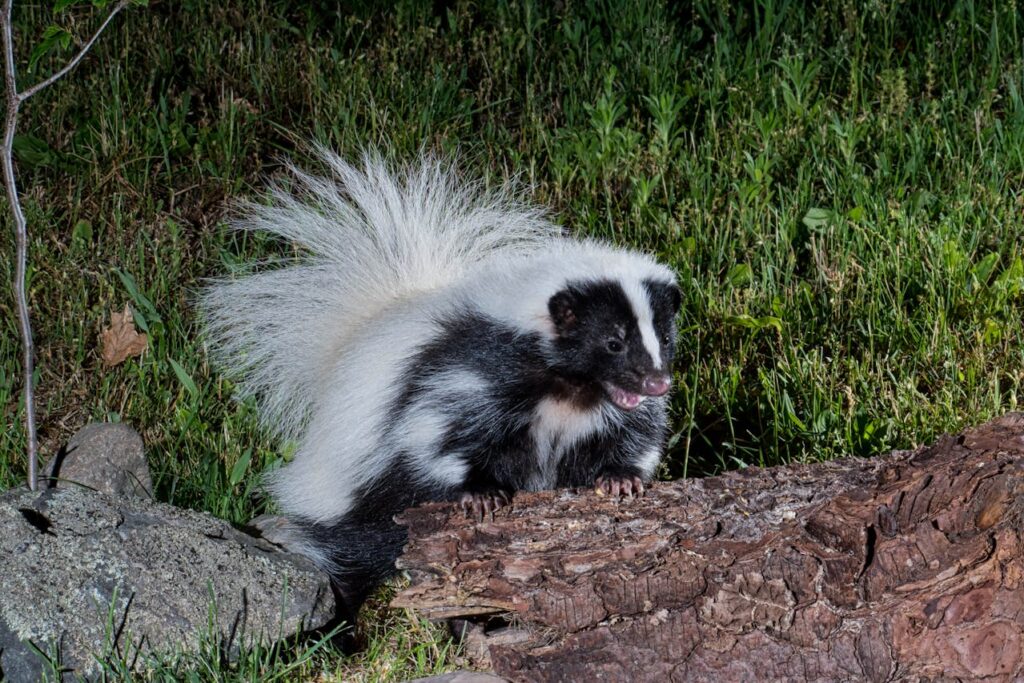
The enigmatic world of wildlife often reveals astonishing capabilities and unexpected behavior among animals. One creature that has piqued curiosity across numerous backyards and parks is the skunk. While often associated with their notorious odor, the question arises: Can skunks climb fences? Delving into this question necessitates an exploration of their physiology, behavior, and the fascinating interactions they have with their environment.
To better understand whether skunks can navigate vertical barriers such as fences, it’s essential to consider their anatomy. Skunks belong to the family Mephitidae, and they possess a unique build that emphasizes ground dwelling and foraging rather than climbing. Their squat bodies entail short, sturdy legs with broad, padded feet, which are fantastic for digging, but do not lend themselves to agility in climbing. While it’s true that skunks can jump or scale low obstacles, they lack the specialized limbs that arboreal animals possess, making high fences a significant challenge.
With an average adult skunk weighing between 6 to 14 pounds, their weight significantly impacts their climbing ability. Coupled with short legs, the skunk’s build is optimized for foraging and scavenging on the ground. When faced with a barrier, their approach is primarily to dig rather than attempt to ascend. This inclination reflects their instinctual behaviors, as they contribute to their primary survival strategies—finding food and avoiding predators.
However, though climbing may not be a skunk’s forte, one must consider their cognitive capabilities. Skunks are equipped with remarkable problem-solving skills that allow them to navigate various environments. They may attempt to explore new obstacles in their range through persistence rather than agility. A skunk might not leap onto a fence, but it could feasibly find a method to burrow beneath it or maneuver around its base to access enticing items on the other side. This adaptability demonstrates their intelligence and resourcefulness in the wild.
Additionally, it’s worth examining the setting where skunks are frequently encountered—urban areas and suburban neighborhoods. Fences often serve as both boundaries and barriers to keep these curious creatures at bay. However, in environments that offer ample food sources, skunks are less hindered by fencing and more driven by the allure of foraging opportunities. There are anecdotal reports of skunks managing to climb slightly over lower fences, particularly if the structure provides any rudimentary footholds. In essence, while a skunk is not an accomplished climber, it might successfully surpass low obstacles when propelled by necessity.
The design of fences also plays a pivotal role. A standard wooden fence, for instance, may present a muted challenge to a determined skunk, especially if the fence’s side is compromised or allows for leverage. Conversely, a tall chain-link fence or one topped with barbed wire effectively deters any attempt at climbing. Thus, it is vital to consider the material and structure of the fencing when assessing its efficacy at keeping skunks out.
Equally critical is understanding the skunk’s behavior in relation to its environment. Skunks are nocturnal creatures, primarily foraging for food at night. Their propensity for scavenging makes them adept at locating edible scraps, whether in trash cans, gardens, or compost heaps. When these food sources are present near the base of a fence, the temptation may outweigh the physical limitations. Garden owners who haven’t utilized sturdy fencing might find their plants nibbled upon, as skunks are surprisingly agile when motivated by hunger.
Nevertheless, there are effective measures that can be taken to curb skunk intrusions. Erecting robust, high fences fortified at the bottom with a barrier that extends underground can prevent these tenacious little animals from burrowing underneath. Sloped fences can also discourage climbing attempts, as skunks are not natural climbers and tend to prefer more level terrain.
Moreover, deploying deterrents such as motion-activated sprinklers or sonic devices can discourage skunks from daring to approach the area altogether. These strategies help create an inhospitable environment for skunks, allowing homeowners to enjoy their gardens without fearing incursions from these misunderstood creatures.
In conclusion, while skunks may not exhibit climbing prowess on par with raccoons or squirrels, their ability to navigate obstacles warrants acknowledgment. Their anatomical specialization directs their behavior towards foraging rather than climbing, yet this does not diminish their resourcefulness in seeking out food. Environmental context, fence design, and adaptability are pivotal in understanding how these fascinating mammals engage with the spaces they inhabit. Therefore, for those looking to keep skunks at bay, a thoughtful mix of strategic fencing and ecological awareness will aid in maintaining boundaries against these intriguing yet notorious neighbors. Embracing a broader understanding of their behavior promises not only to mitigate unwanted encounters but also to foster a deeper appreciation for the resilience of wildlife that shares our spaces.











Leave a Comment