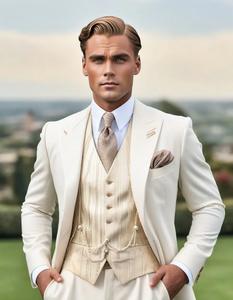
In the vivid tapestry of F. Scott Fitzgerald’s “The Great Gatsby,” fashion plays a pivotal role, providing insight into the characters’ social standings, aspirations, and identities. The male attire in the novel serves not only as a reflection of the opulent Jazz Age but also as a crucial element of the narrative, accentuating themes of ambition, class, and the transient nature of the American Dream. Have you ever wondered how clothing choices can transcend mere fabric to reveal deeper societal truths? This exploration delves into the sartorial elegance of male characters in the novel and how their wardrobes embody both allure and illusion.
The male protagonist, Jay Gatsby, epitomizes the essence of 1920s fashion. His wardrobe is marked by extravagant choices that encapsulate his wealth and desirability. The quintessential Gatsby ensemble often features a meticulously tailored suit, characterized by its sharp lines and luxurious fabrics. A light-colored suit – perhaps in pastel shades of pink or cream – suggests not only extravagance but also an attempt to distinguish himself from the drabness of his humble beginnings. This sartorial statement raises a question: is it possible for one’s attire to mask their true identity?
Accompanying his stunning suits, Gatsby often dons an equally extravagant accessory – a pocket square. This seemingly trivial addition to his outfit serves as a metaphor for his aspirations. It transforms an already dapper look into a spectacle of flamboyance, highlighting a man who desires to impress and win over Daisy Buchanan. When attending lavish soirées, Gatsby’s choice of a bow tie further accentuates his polished persona. Herein lies a challenge: how can one balance individuality with societal expectations while stringently adhering to fashion norms?
In stark contrast is Tom Buchanan, Gatsby’s rival and a personification of established wealth. Tom’s clothing choices mirror his brute confidence and adherence to traditional masculinity. His preferred ensembles typically consist of darker, more conservative colors, favoring robust materials that project a sense of power and authority. A heavy wool suit paired with a plaid tie speaks of a man rooted in his class privilege – one who derives security from the status quo. Through Tom’s attire, Fitzgerald prompts a contemplation of how attire can communicate the broader narrative of inherited wealth versus acquired status.
Moving beyond Gatsby and Tom, we encounter other notable characters whose fashion choices further enrich the narrative. For example, Nick Carraway, the novel’s narrator, dresses with an understated elegance that contrasts sharply with Gatsby’s ostentation. Nick’s choice of simple, well-fitted suits underscores his role as an observer and commentator, maintaining a neutrality amidst the chaos of high society. This brings to light the question of how clothing can influence one’s role in social dynamics and perceptions. Nick’s attire, while less flamboyant, remains crucial in conveying his character’s complexity and moral compass.
Let’s not forget Myrtle Wilson, Tom’s mistress whose fashion choices exemplify her aspirations to ascend the social ladder. Her attire often oscillates between the glamorous and the garish, reflecting her desires while highlighting her pretentiousness. A vivid dress, adorned with bold colors, symbolizes her relentless pursuit of a lifestyle she believes will redeem her from her mundane existence. Yet, it also exposes her vulnerability; her clothes communicate a mismatch between her reality and desires. This dynamic leads to significant reflections on authenticity and the power of apparel in shaping one’s narrative.
The accessory game in “The Great Gatsby” further intensifies the discourse on fashion’s relevance. The right pair of shoes or a stylish hat can amplify one’s status in a society obsessed with appearances. For instance, Gatsby’s exquisite footwear, likely crafted from the finest leathers, reinforces his image of success and sophistication. This presumption leads to an intriguing consideration: can a well-chosen accessory elevate an outfit to new heights, embellishing the wearer’s persona? As characters navigate their social circles, their choice of accessories—be it cufflinks or silk ties—strategically serves to enhance or distort their identities.
In analyzing the clothing of male characters in “The Great Gatsby,” one cannot overlook the broader implications of fashion in the Jazz Age. It was an era defined by excess, and clothing was a potent symbol both of personal worth and social status. The stark differences between the wardrobes of the characters elucidate the core tensions of the narrative – the conflict between old money and new desires. As one engages with the text, a vital question emerges: how do the sartorial choices of these characters contribute to the themes of aspiration, identity, and the inevitable disillusionment of the American Dream?
Ultimately, the clothes worn by the male characters in “The Great Gatsby” transcend mere aesthetic choices; they emerge as crucial instruments through which Fitzgerald critiques the complexities of class and aspiration. Clothing becomes a canvas on which the author’s criticisms of societal norms are painted with vivid detail. In appreciating their outfits, one cannot help but ponder the intricate dance between appearance and authenticity, aspiration and reality. As we navigate our own sartorial choices, perhaps we too should contemplate: what stories do our clothes tell in the tapestry of modern society?










Leave a Comment