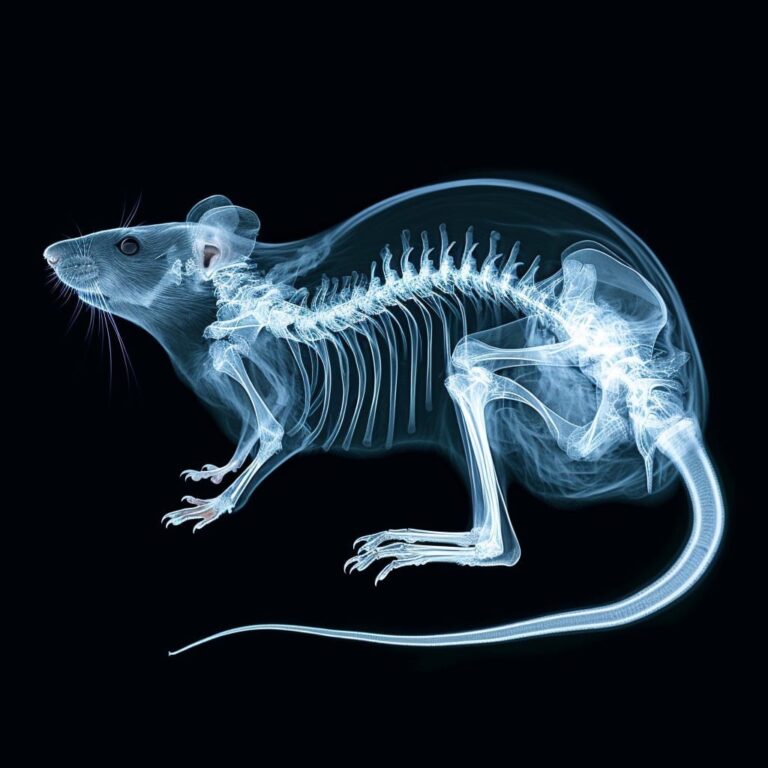
Rats, those ubiquitous survivors of our urban landscapes, evoke a myriad of emotions in human hearts and minds. Some gaze upon them with revulsion, while others observe their intrinsic elegance. Beneath their fur and beneath the surface of societal prejudice lies a fascinating question: Do rats have bones? This exploration takes us on a journey not only into anatomy but into the very heart of biological resilience and adaptation.
To understand the skeletal structure of rats, we must first recognize their categorization within the animal kingdom. Rats belong to the order Rodentia, a classification that boasts an extensive array of species, all characterized by their unique adaptations and ecological roles. As creatures of both rural and urban environments, their anatomical composition is crucial to their survival in diverse habitats.
Rats, like all mammals, possess a structured internal framework comprising bones. Their skeleton, a masterpiece of architectural efficiency, consists of over 200 bones, intricately designed to support their agile bodies. Much like a finely tuned instrument, their skeletal system allows them to navigate the crevices of society—from the sewers to the rafters, employing their dexterous limbs and stunningly flexible spine.
Each section of a rat’s skeletal structure serves a distinct purpose, functioning much like the finely crafted gears in a clock. The axial skeleton, which includes the skull and vertebral column, forms the core of their anatomical integrity. The skull, a dome of protection, houses the delicate and complex brain, enabling cognitive prowess that belies their diminutive size. Interestingly, rats possess an exceptional olfactory system, and the vast nasal passages within their skulls can be likened to an expansive library of scents, allowing them to navigate and interact with their world in remarkable ways.
Moving outward, one finds the appendicular skeleton—an intricate network of bones comprising limbs crucial for locomotion. Rats exhibit remarkable agility and grace, their long, slender tails serving as rudders during swift movements. The bones of their limbs, particularly the forelimbs, are structured enabling nimble climbing and burrowing. It is almost poetic, the way their bodies adapt to challenges, metamorphosing into living embodiments of survival.
One might ponder the uniqueness of their bone structure. Unlike humans, the long bones in a rat’s body are comparatively lighter and less dense, allowing for enhanced flexibility and sprinting prowess. This remarkable adaptation aids them in evading predators, scaling heights with ease, and slipping through the narrowest of openings—a feature that amplifies their reputation as cunning survivors. Imagine a master locksmith, effortlessly maneuvering through the locks of existence, each bone a tool in their arsenal.
Moreover, the distinct characteristics of rat bones reveal intriguing evolutionary narratives. Rats possess a unique bone composition that minimizes weight while maintaining strength—an exquisite balancing act. Such adaptations not only support their frenetic lifestyle but also exemplify the wonders of natural selection. In an environment filled with hazards, those who evolve tend to flourish, embodying the essence of resilience.
Still, it is important to recognize that the skeletal framework is not merely a passive structure; it is an active participant in the rat’s life experiences. Like a canvas being painted upon, the bones of a rat respond to strains and stresses, adapting and repairing through a process known as bone remodeling. This curious phenomenon showcases nature’s remarkable ability to shape and reshape through experience, much like an artist refining their craft.
But in the grand tapestry of life, rats are not solitary figures. Their social structures and interactions reveal complex behaviors and relationships. Skulking within the shadows, sometimes viewed as mere pests, they exhibit intelligence and community dynamics that are both fascinating and endearing. They engage in grooming rituals, establish hierarchies, and form bonds akin to familial ties. The skeletal system, of course, plays an integral role in their social prowess, permitting the physical expressions of these interactions.
Understanding whether rats have bones invites us to rethink our perceptions of these resourceful mammals. Beneath the fur and the stigma lies a creature that has thrived through epochs. The bones, sturdy and light, narrate tales of adaptation and survival. Indeed, each rat is a living testament to the marvels of evolution, possessing a skeletal system that enables not just existence, but a life rich with social complexity and cunning innovation.
In conclusion, the inquiry into whether rats possess bones unveils a deeper narrative about our world. These structures do more than just support; they symbolize resilience against adversity. They signify adaptability in a rapidly changing environment, much like humanity itself. As we navigate the intricacies of our lives, perhaps we can draw inspiration from these small scavengers, whose bones carry the weight of survival and whose very existence challenges the bounds of perception and understanding.











Leave a Comment