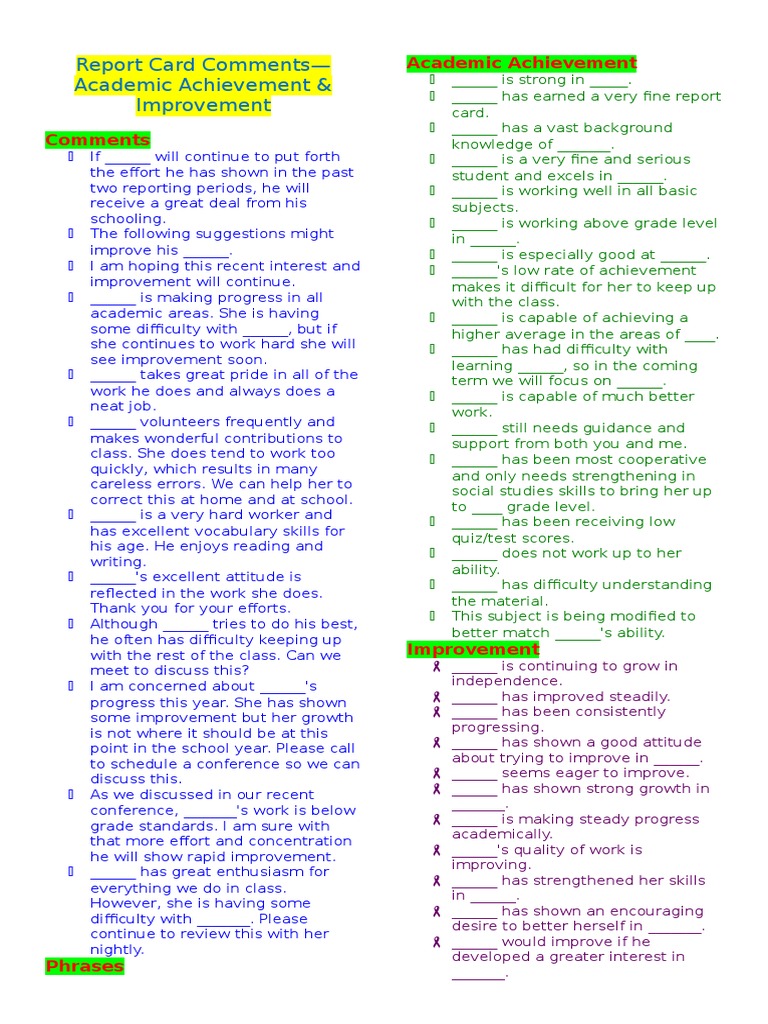
In the grand tapestry of education, the report card serves as a vital thread—one that weaves together the accomplishments, challenges, and aspirations of students. Each comment penned alongside grades represents a unique narrative, a window into the learner’s experience. It is not merely a reflection of academic prowess but an intricate portrayal of growth, potential, and the odyssey through knowledge. Herein lies an exploration of the art of crafting comments on a report card, transforming them from mere annotations into evocative reflections.
1. The Foundation of Context
To begin with, establishing context is paramount. Every student’s journey is distinct, shaped by personal experiences, learning environments, and individual challenges. As comments are articulated, it is crucial to consider the broader landscape in which a student operates—societal influences, family background, and even emotional well-being. These diversifying elements form the bedrock upon which academic achievements are built, and recognizing them in report card comments cultivates a deeper understanding.
2. Celebrating Academic Triumphs
Within the realm of a report card, academic achievements shine like brilliant constellations against the dark canvas of struggles. A well-crafted comment should not only acknowledge high grades but also illuminate the effort and determination behind those scores. Phrases such as “exhibited remarkable perseverance in mastering challenging concepts” encapsulate the spirit of achievement while adding depth to the grade. The choice of language can evoke a sense of pride and motivation, transforming triumphs into lasting encouragement.
3. Constructive Criticism: The Gentle Art of Guidance
However, the path to success is seldom linear. Constructive criticism serves as the guiding light, illuminating areas for improvement without extinguishing the flame of ambition. Comments should be framed with empathy, fostering a growth mindset. Instead of saying “needs improvement,” a more nuanced phrasing—such as “would benefit from focusing on collaborative skills to enhance participation”—nurtures the student’s self-esteem while gently steering them toward development.
4. The Importance of Personality Insights
Beyond academic performance lies the fascinating realm of personal development. Comments that explore the student’s character traits can provide invaluable insight. Observations such as “demonstrates commendable leadership qualities” or “exudes a contagious enthusiasm for group projects” highlight the unique contributions a student brings to the classroom environment. By doing so, report cards evolve into comprehensive portraits of the individual, underscoring attributes that transcend mere numerical evaluations.
5. Balancing Specifically with General Observations
Just as a painter must balance distinct strokes with sweeping gestures to create a beautiful canvas, comments on a report card should strike a harmonious chord between specificity and generality. General comments may provide a holistic view of the student’s progress, but these should be laced with specifics to ground the feedback. For instance, stating “showed improvement in math skills this quarter, particularly in understanding fractions” balances the need for a broader perspective with concrete examples, allowing both parents and students to visualize growth.
6. Engaging the Home Front
It is imperative that report card comments do not exist in isolation. They should serve as a bridge between school and home, fostering collaboration in the educational journey. Including phrases like “parents are encouraged to support ongoing reading practices at home” engages family members in the learning process. When comments invite parental involvement, they facilitate a supportive network that extends beyond the confines of the classroom, ensuring the student’s growth is nurtured on all fronts.
7. The Power of Positivity
In the intricate web of feedback, positivity exerts a magnetic pull. Optimistic language—whether through the use of affirming adjectives or uplifting phrases—can significantly influence a student’s self-perception. Instead of concluding with a simple score or remark, one might relay, “Your efforts have laid a strong foundation for future learning,” thus instilling hope and fostering a lifelong love for learning. It is essential to end comments on a note of encouragement, leaving students feeling valued and inspired.
8. The Continuous Journey of Reflection
The comments on a report card should not serve as a final testament but rather as a chapter in an ongoing narrative. Encouraging students to reflect on their progress and to set goals for the future enhances autonomy and fosters a sense of responsibility for their learning journey. A comment such as “Considering your progress, I encourage you to set specific goals for the next quarter” cultivates a proactive approach to education, propelling students toward greater heights.
As we delve into the world of report card comments, we unearth their myriad forms—a vessel for storytelling, a beacon of hope, and a call to action. Each comment invites us to engage in the ongoing educational dialogue, a discourse rich with intention and insight. Ultimately, the essence of report card comments lies not solely in the grades but in the tales they tell—the transformation of young minds through persistence, creativity, and the quest for knowledge. Thus, the next time a report card emerges, let it be accompanied by words that inspire, guide, and paint a vivid picture of potential yet to be realized.









Leave a Comment