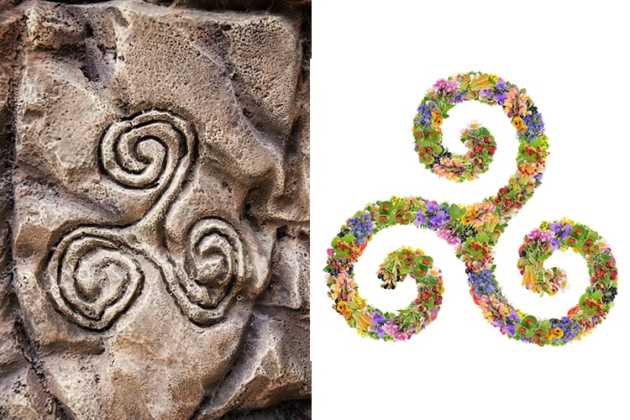
Within the quiet chambers of history, symbols often beckon us to contemplate their depths. One such emblematic figure is the triskele, a motif rich in culture, mythology, and philosophical resonance. At first glance, this intriguing design, typically characterized by its three interlocking spirals or branches, captivates attention with its simple elegance. Yet, beneath this façade lies a profound tapestry of significance, weaving together three-dimensional interpretations of existence, motion, and the cyclical nature of life.
In the echoes of ancient Celtic tradition, the triskele emerges as a powerful symbol, embodying concepts far beyond its geometric simplicity. Often interpreted as a representation of the three realms—land, sea, and sky—it serves as a reminder of the interconnectedness that defines our universe. This triadic formation invites us to explore the harmonious balance and symmetry inherent in nature. It reflects the ancient wisdom that all aspects of life are intertwined, forming an intricate web that transcends the individual.
Equally enchanting is the triskele’s thematic triad of life cycles: birth, death, and rebirth. This cycle illustrates the perpetual dance between creation and dissolution, akin to the eternal ebb and flow of the tides. Each spiral progresses into the next, symbolizing the ceaseless motion of the universe, where endings are but preludes to new beginnings. Imagine standing at the shores of existence, watching the waves roll in: each crest a birth, each trough a fleeting death, ultimately cascading into the return of the cycle. The triskele serves as a poignant reminder that in every conclusion, there exists the seed of a new genesis.
Additionally, the triskele holds a significant place in the realms of spirituality and personal growth. Each spiral can be seen as a metaphor for the human experience, drawing attention to the dimensions of mind, body, and spirit. The integration of these elements forms a holistic approach to well-being, encouraging individuals to nurture each facet of their existence. Just as the spirals intertwine, so too must we intertwine our thoughts, actions, and emotions to achieve balance and enlightenment.
Furthermore, the triskele speaks to the triad of past, present, and future, serving as a visual reminder that our experiences are interwoven into the fabric of time. Like a river that continuously flows, the currents of our memories shape our identities, while our actions ripple forward into what is yet to come. This concept challenges us to live in awareness, understanding that our choices in the present moment ripple into eternity. To engage with the triskele is to embrace the dance of time—an invitation to navigate one’s life with intention and foresight.
The design’s versatility extends beyond cultural representation; in art and architecture, it has inspired countless interpretations throughout the ages. From ancient Neolithic tombs to modern-day jewelry, the triskele’s artistic manifestations invoke a sense of timelessness. It is a bridge between epochs, where ancient reverence meets contemporary aesthetics. Artists draw upon this symbol not only as a motif but as a canvas for exploring themes of eternity, transformation, and unity, inviting viewers to reflect on their own journeys.
Moreover, the triskele resonates deeply with the philosophies of many cultures, transcending geographic and temporal boundaries. In some instances, it is interpreted as a symbol of the earth’s elements—earth, water, and fire—each spiral representing a fundamental force that shapes our reality. This interpretation prompts contemplation of our intrinsic connection to nature and the sanctity of the world around us. It compels us to recognize the beauty that dwells in the ordinary and to appreciate the elemental forces that sustain life.
The symbol has also played a role in religious contexts, often associated with deities and sacred rituals. In its capacity as a spiritual emblem, the triskele invites us to ponder the divine aspects of existence. The interconnecting spirals may represent the union of the temporal and the eternal, signifying the divine dance of creation throughout the ages. By contemplating this dimensionality, individuals can explore their own spirituality and seek a connection to a greater universal energy.
As we delve deeper into the meaning of the triskele, it becomes evident that its allure lies in its intricate simplicity. It evokes a sense of wonder and introspection, urging us to contemplate the essence of our being. Within its spirals, we find reflections of ourselves and the world we inhabit—a microcosm of the universe that encourages us to embrace the multiplicity of existence. Each spiral beckons us to traverse the expanse of our experiences, to honor the past, navigate the present, and dream of future possibilities.
Ultimately, the triskele invites us to experience life as an interconnected journey, where every moment is an exploration of potential. It reminds us of the unity that lies within diversity, and the beauty found in embracing the cycles of life. As we continue our quest for understanding, may we carry the essence of the triskele with us—an emblem of connection, transformation, and the timeless dance of existence. In so doing, we engage not only with a symbol but also with the rich tapestry of life itself, drawing from its wisdom as we navigate our own spirals through the unfolding journey of existence.








Leave a Comment