The world of colors is an intricate tapestry, woven from threads of perception and emotion. It entices not only the eye but also the heart, often leaving us pondering the mysteries locked within its depths. Among the myriad of queries that surface in the realm of color theory, the question, “Do purple and blue make red?” stands out as a vivid enigma, a puzzle that dances at the precipice of understanding and wonder.
At its very core, the interaction of purple and blue is a revelatory exploration of color dynamics. To unpack this conundrum, we must first delve into the essence of both colors. Purple, a regal shade born from the amalgamation of red and blue, carries with it an air of sophistication and mystery. It whispers tales of creativity and spirituality, often associated with royalty and grandeur, inviting contemplation. Blue, on the other hand, radiates tranquility and assurance, echoing the vastness of the sky and the depths of the ocean. It evokes a serene calmness, reminiscent of a gentle breeze on a crisp morning.
In the context of additive color mixing, where light blends to create new hues, purple and blue engage in a harmonious ballet, swirling together yet never morphing into that elusive red. Rather, they coalesce into an even deeper shade of blue—perhaps a deep indigo or violet that transcends their individual identities while remaining distinct.
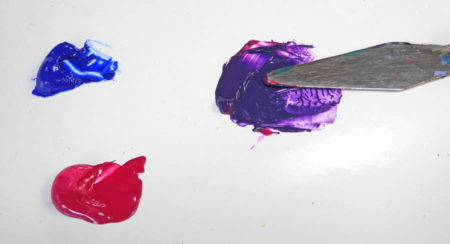
Conversely, in the realm of subtractive color mixing—found in pigments and paints—when two colors are blended, the outcome diverges from the additive paradigm. Here, blending equal parts of purple, a pigment derived from red and blue, with blue may produce an intense blue or even a muted tone but resists the transformation into red. This phenomenon embodies the essence of color interaction; it highlights that mixing colors often leads to unexpected, sometimes paradoxical results.
Beyond the scientific dissection, the relationship between purple and blue can serve as a profound metaphor. Picture a deep azure ocean meeting the twilight sky on the horizon—a splendid gradient that envelops both realms in an embrace of serenity. This imagery resonates deeply with the notion that interactions between colors can symbolize various emotional states and psychological experiences. Much like relationships between individuals, the blend of purple and blue embodies unity, balance, and the pursuit of harmony while maintaining their distinctive traits.
To further explore this delightful interplay, let us consider color wheels—a tool used by artists and designers to visualize and understand color relationships. When viewed in the context of a traditional color wheel, one observes that purple and blue sit adjacent to each other, emphasizing their inherent connection. They are akin to close companions, each supporting and enriching the other’s presence without losing their unique essence. Hence, when they coexist, they create a visual tapestry that can be profoundly striking, much like a symphony composed of harmonious melodies that do not overshadow each other.
Additionally, the psychological implications of purple and blue cannot be overlooked. Purple is often associated with creativity, imagination, and inspiration, urging us to explore the unknown. It invites a dance of thoughts akin to the vibrant strokes of a brush painting a canvas, while blue evokes stability and trust. Together, they forge a unique partnership; merging these two colors in design or art can elicit feelings of tranquility infused with creative energy, making it a favorite palette choice in branding and décor.
The exploration of whether purple and blue combine to create red brings forth further considerations involving the context in which colors are perceived. Cultural interpretations also play a significant role in how colors are perceived. For example, in Western cultures, purple is often linked with spirituality and luxury, while blue embodies calmness and reassurance. In contrast, other cultures may imbue these colors with entirely different meanings, highlighting the subjective nature of color perception and integration. Thus, the complexity of color transcends mere physics and dives into the depths of human emotion and societal constructs.
Furthermore, the digital age has ushered in a new era where color mixing is not merely a physical endeavor but also a digital one. Software design, graphic design, and digital art have expanded the palette, allowing creators to explore uncharted territories where colors now blend in infinite possibilities. Thus, in a modern context, even the question of purple and blue transforming into red may open the floodgates of innovation, illustrating how technology adds another layer to the lively discourse of color theory.
Ultimately, the question of whether purple and blue make red serves as a fascinating portal into a broader understanding of colors and their symbiotic relationships. It highlights the beauty of exploration, both visually and metaphorically. Engaging with colors invites us to embrace complexity, challenge perceptions, and transcend the ordinary. Just as in life, where relationships and experiences seldom yield straightforward results, the journey through the spectrum of color offers its own twists and turns, illuminating the extraordinary beauty that lies within the unexpected.
In conclusion, while purple and blue do not produce red in a straightforward manner, they engage in a captivating dialogue that hints at identity, relationships, and the endless possibilities of blending the known with the unknown. As we navigate the vibrant landscapes of color, may we remember that every blend, every hue, contributes to the grand tapestry of our experiences, inviting us to revel in the exquisite interplay of light, shadow, and emotion.









Leave a Comment