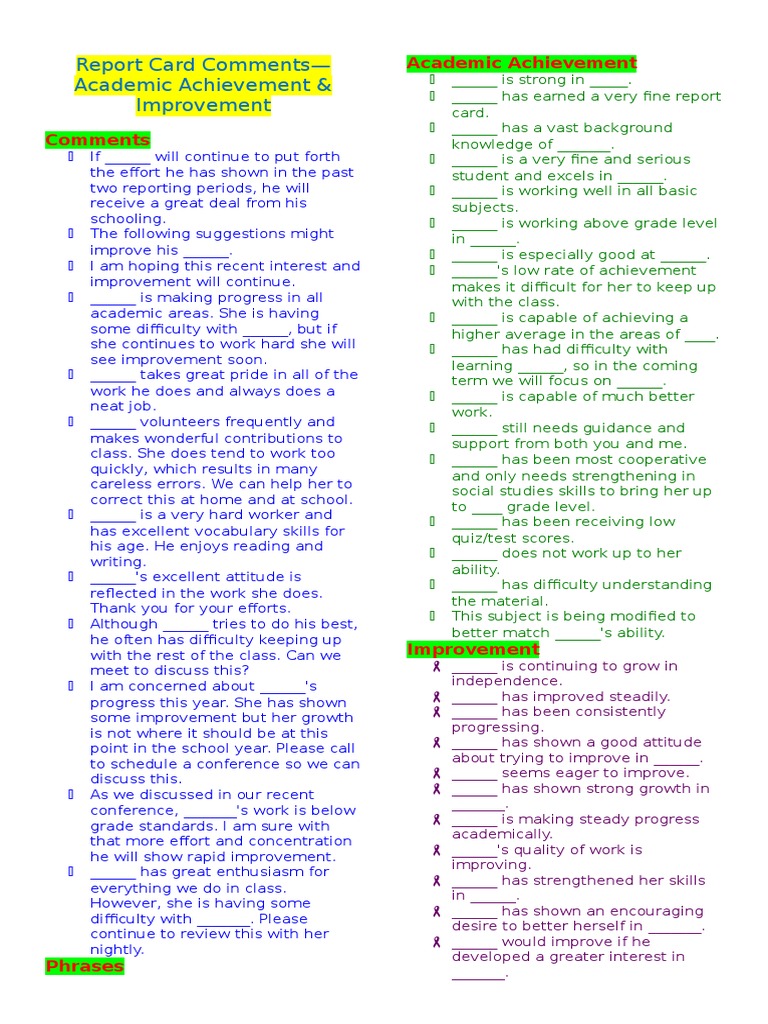
Report cards serve as vital tools for assessing student performance and providing critical feedback to parents, teachers, and students alike. Comments on the report card can vary immensely, reflecting not only academic achievements but also essential social and emotional developments. Crafting appropriate comments can enhance the reader’s understanding of a student’s overall progress. This article will explore the different types of content one might encounter in report card comments and how they contribute to a comprehensive evaluation of a student’s experience and growth.
1. Academic Performance
The foundation of any report card lies in the assessment of academic performance. Comments related to this domain typically highlight key subjects, such as mathematics, language arts, science, and social studies. Educators may illuminate specific skills, such as problem-solving in mathematics or comprehension in reading. For instance, a comment could state, “Jane demonstrates a remarkable proficiency in solving complex equations, showcasing her strong analytical skills.” Such evaluations give parents insights into what their child excels at or where they need further assistance.
This section may also include observations on a student’s work ethic, such as “Mark consistently demonstrates diligence in completing assignments,” or comments on participation, such as “Sarah’s contributions to group discussions are invaluable.” These insights are instrumental in helping parents understand their child’s classroom behavior and engagement levels.
2. Social Interaction and Collaboration
Beyond academics, a significant aspect of a student’s experience revolves around social skills and collaboration with peers. An effective report card may contain remarks addressing a student’s interpersonal relationships, ability to work within teams, and overall contribution to the classroom environment. A comment like, “James excels in group settings, often taking the initiative to guide his peers toward common goals,” underscores the importance of collaboration in educational settings.
Comments may also reflect how students resolve conflicts and relate to their peers. For example, “Emily has shown remarkable improvement in sharing and considering others’ ideas during group projects,” can indicate a growth mindset and emotional intelligence that are crucial for long-term success. Such observations prepare students for real-world interactions, emphasizing the importance of social development alongside academic achievement.
3. Behavioral Insights
Behavioral comments provide essential insights into a student’s self-regulation, attitude towards learning, and overall conduct in the classroom. These remarks can range from praising good behavior to addressing challenges that may impact the learning environment. For instance, a teacher might note, “Liam has improved significantly in managing his impulses,” which could indicate ongoing behavioral progress or the effective implementation of strategies.
On the contrary, if a student is struggling with certain behaviors, comments may read, “Sophie occasionally finds it difficult to stay focused during lessons, and strategies are being implemented to assist her.” This honest yet constructive feedback allows parents to engage in conversations about their children’s behavior at home and aligns them with the school’s approach to their child’s development.
4. Growth and Development
Comments that address growth and development focus on the student’s learning journey over the term. These remarks go beyond mere performance metrics and encapsulate the student’s resilience, adaptability, and overall evolution. For example, a comment could highlight, “Nathan has shown tremendous progress in his writing skills, developing a more coherent and expressive style throughout the semester.” This encapsulation of growth can motivate students and provide them with a sense of accomplishment.
Moreover, comments reflecting on personal growth, such as “Maria has cultivated greater curiosity in science, often asking insightful questions that enhance her learning experience,” can nurture a student’s intrinsic motivation. Such affirmations can push students to pursue further interests and ambitions in their academic lives.
5. Recommendations for Improvement
Constructive feedback is a crucial element of report card comments, providing actionable recommendations for further improvement. Educators may offer specific suggestions tailored to the student’s needs. For instance, “To further enhance her reading comprehension, Lila is encouraged to engage in additional reading at home,” galvanizes parents to get involved in their child’s academic journey. This proactive approach implies that learning is a collaborative effort between educators and families.
Other comments might suggest developing organizational skills or practicing time management for students who may struggle with workload management. For instance, “Jack would benefit from creating a weekly planner to keep track of assignments and deadlines.” This not only points out areas of concern but also provides a roadmap for improvement, empowering students and their families to take actionable steps.
6. Closing Remarks and Encouragement
Finally, effective report card comments often conclude with encouraging remarks that inspire students and reaffirm their potential. Positive reinforcement serves as a crucial motivator. Comments may read, “With continued persistence and effort, Emma will undoubtedly achieve great things,” or “I look forward to observing Lucas’s progress in the upcoming term.” Such affirmations build confidence and create an environment that celebrates both effort and achievement.
In summary, comments on report cards encompass a variety of aspects that contribute to a student’s holistic assessment. From academic performance to social skills, behavioral insights, and actionable feedback, each category plays a vital role in painting a comprehensive picture of a student’s overall experience. The essence of these comments lies not merely in grading but in fostering growth, encouraging engagement, and celebrating achievements in every dimension of a student’s educational journey.











Leave a Comment