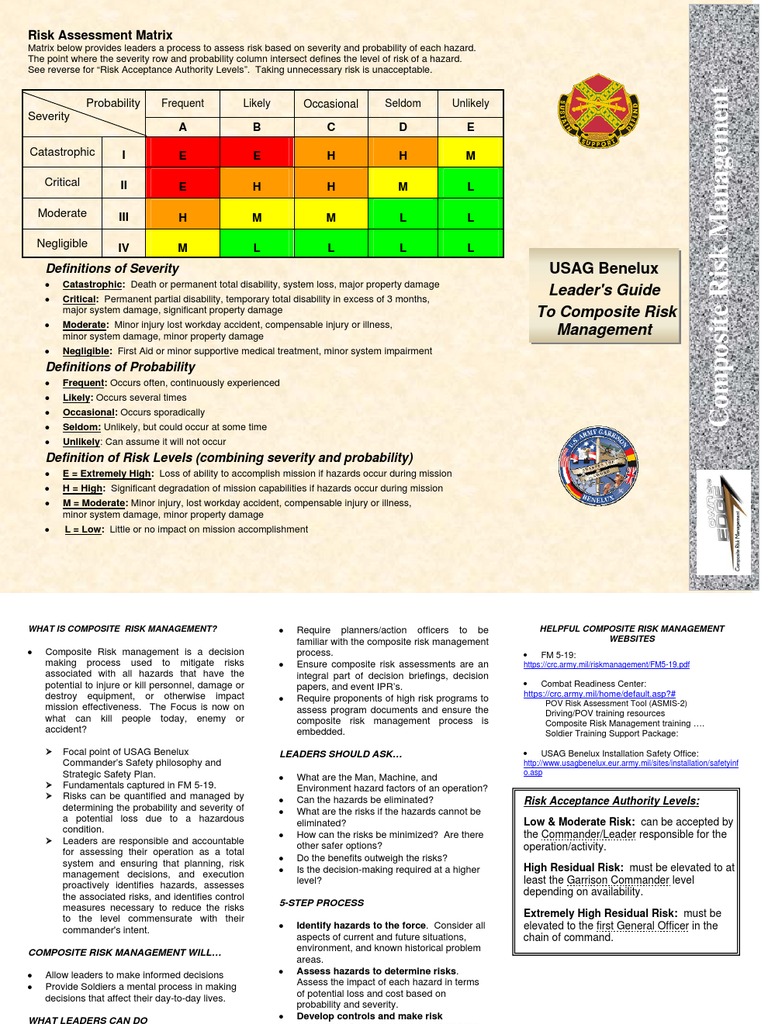
In today’s dynamic environment, the concept of Composite Risk Management (CRM) signifies a crucial and intricate aspect of operational safety and decision-making processes. It underscores a comprehensive methodology designed to identify, assess, and mitigate risks that organizations face in their pursuits. This article delves into the nuances of composite risk management, elucidating its definition, significance, processes, applications, and the challenges it presents.
The term “Composite Risk Management” embeds a multilayered understanding of risk that transcends traditional risk assessment methods. While many organizations may approach risk in isolation—focusing solely on singular threats—CRM encourages a panoramic evaluation of risks. This approach examines the interplay between various elements and fosters holistic solutions. It is this broad-spectrum view that cultivates a fascination with CRM, as it acknowledges that risks are rarely independent; rather, they exist within a complex ecosystem where one risk can precipitate a cascade of others.
Understanding Composite Risk Management
At its core, Composite Risk Management is an integrative approach that amalgamates various risk factors associated with organizational objectives. Risk is not merely assessed based on likelihood or impact; it is framed within the larger context of interdependencies. This management strategy goes beyond merely categorizing risks as either acceptable or unacceptable; it necessitates a nuanced analysis that factors in the cumulative effects of multiple risks.
To appreciate CRM fully, one must first understand its essential components:
1. Risk Identification
The initial step in CRM involves an exhaustive identification of potential risks. These may range from operational threats, such as machinery malfunctions or supply chain disruptions, to external factors like regulatory changes and market volatility. Techniques such as brainstorming sessions, expert consultations, and historical data analysis serve as vital tools in this phase. However, what sets CRM apart is its insistence on viewing these risks not in isolation, but in relation to one another, creating a matrix of potential interactions.
2. Risk Assessment
Once risks are identified, the subsequent phase involves assessing their significance. This necessitates evaluating both the probability of occurrence and the potential repercussions inherent in each risk. However, the evaluative process in CRM is marked by a composite perspective; it considers how risks might amplify or mitigate one another. For instance, the delay in project timelines due to one risk factor might exacerbate financial loss projected by another, thus amplifying the overall risk profile.
3. Risk Mitigation
After thoroughly assessing risks, the focus shifts to the development of mitigation strategies. This involves prioritizing the risks based on their combined impact and crafting tailored responses. Mitigation strategies may entail implementing preventive measures, developing contingency plans, and fostering organizational resilience through adaptive strategies. Central to this phase is the cultivation of cross-functional collaboration, ensuring diverse expertise is harnessed to address layered risks effectively.
4. Monitoring and Review
Composite Risk Management is not a one-time exercise; rather, it is an ongoing cycle characterized by vigilance and adaptability. Continuous monitoring of the risk environment is essential, as new threats emerge and existing risks evolve. Organizations must periodically review their risk profiles, assess the efficacy of their mitigation strategies, and adjust them accordingly. This phase is vital for ensuring that risk management efforts remain relevant and robust over time.
Applications Across Sectors
The application of Composite Risk Management transcends industries. In manufacturing, CRM can facilitate the identification of risks associated with supply chain disruptions and workplace safety issues. In finance, it aids in recognizing interrelated market risks that could threaten investment portfolios. Moreover, in healthcare, CRM provides a framework for managing patient safety risks while enabling healthcare organizations to navigate regulatory challenges. The adaptability of CRM across diverse sectors illustrates not only its significance but also its universal appeal.
Challenges in Implementing Composite Risk Management
Despite its myriad advantages, enterprises may encounter obstacles when implementing a Composite Risk Management strategy. A notable challenge is the complexity inherent in accurately identifying and quantifying the interconnectedness of various risks. Organizations may grapple with scarce resources or insufficient expertise to undertake a comprehensive analysis. Moreover, fostering a culture that embraces open communication and cross-departmental collaboration is indispensable for the success of CRM but can be difficult to cultivate.
The Broader Significance of CRM
Engaging in Composite Risk Management goes beyond mitigating immediate threats; it cultivates a culture of proactive awareness and strategic foresight. Organizations that embrace CRM are better positioned to navigate uncertainty, make informed decisions, and ultimately thrive in a competitive landscape. Furthermore, this integrative approach fuels innovation, encouraging organizations to reassess and refine their operational frameworks.
In conclusion, Composite Risk Management represents an advanced stratum of risk assessment and mitigation that harmonizes diverse risk factors into a cohesive management strategy. As organizations increasingly encounter multifaceted challenges, the fascination with CRM stems from its comprehensive and interdependent approach, which transcends conventional risk management paradigms. Understanding and applying CRM not only safeguards assets and people but also fortifies an organization’s resilience in the face of an ever-changing world.










Leave a Comment