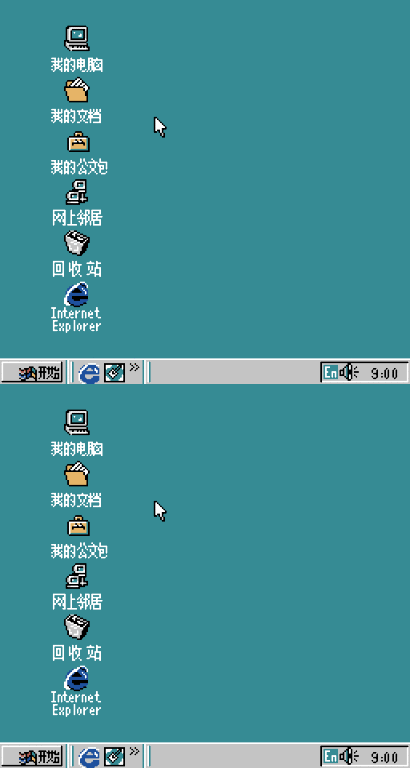
When considering the evolution of computing architecture and operating systems, the saga of Windows 98 brings forth a fascinating inquiry: Did Windows 98 support NTFS, the New Technology File System that many hailed as a revolutionary leap forward in data management? The answer, though seemingly straightforward, beckons a deeper exploration of the intricacies of file systems and the technological landscape of the late 1990s.
To embark upon this discussion, it’s crucial to delve into the distinct frameworks of file systems. Windows 98 was a continuation of the Windows 95 lineage, and as such, it primarily relied on the File Allocation Table (FAT) file system. FAT32, a version of this file system, was embraced for its capacity to handle larger partitions and files, a significant advancement over its predecessors. NTFS, introduced with Windows NT, offered functionalities that were markedly superior, encompassing security features like file permissions and recovery features that were pivotal for enterprise-level applications.
The foundational query leads to the subsequent discussion on NTFS compatibility. Windows 98 did not natively support NTFS. In fact, the operating system was built around a fundamentally different architecture designed for consumer use, rather than business applications where NTFS would typically come into play. The lack of support for NTFS in Windows 98 can almost be seen as a reflection of the segmentation in Microsoft’s strategy—designing Windows 98 for ease of use and broad accessibility while reserving more sophisticated functionalities for the NT series aimed at professional users.
It is important to understand why NTFS was developed in the first place. In an era when computers were becoming ubiquitous in both personal and corporate environments, the demand for a more resilient and efficient file management system surged. NTFS was engineered to meet these demands, incorporating features like journaling, which helps in data recovery after a crash, and volume shadow copy, instrumental for backups. These robust features delineated it from FAT32, a file system that, despite its widespread use, fell short in reliability in more demanding environments.
Yet, while Windows 98 was entrenched in FAT32, it is intriguing to note that users could employ third-party software solutions, which allowed for some NTFS compatibility, albeit with limitations. Such workarounds would let users access NTFS partitions, albeit lacking the full functionality that Windows NT users experienced. This exemplifies a persistent curiosity within the computing community—a longing to bridge gaps, even when official support was absent. The interest in such adaptations highlights the broader trend of users desiring enhanced performance, even if it necessitated navigating the complexities of unofficial support.
Additionally, the intricate relationship between FAT32 and NTFS during this era raises questions about the nature of user experience and expectations. Operating systems historically had to balance between functionality, security, and usability. The FAT32 system, while simpler, was conducive to a wider audience, allowing easier access and manipulation of files. Windows 98, with its friendly GUI, was emblematic of a push towards making technology more approachable, while NTFS represented a paradigm of increasing complexity aimed at addressing the demands of more sophisticated users.
In the subsequent years, as Microsoft transitioned towards Windows 2000 and later iterations, NTFS became the standard, reflecting a shift in user expectations as security, reliability, and data integrity grew paramount. This evolution not only underscores the technological advancements in file systems but also traces the trajectory of user needs over time, illustrating how Windows 98 served as a transitional platform that paved the way for these more developed operating systems.
Moreover, the diverse landscape of file systems in the late 1990s can be seen as a microcosm of the larger technological movements within personal computing. The dominance of FAT32 in Windows 98 served both as a testament to the simplicity desired by everyday consumers and a contrast to the more complex architectures being developed for enterprise needs. This dichotomy invites us to ponder the underlying currents of user philosophy—whether simplicity prevails as a priority, or if the allure of sophisticated capabilities drives user engagement.
As we reflect on why Windows 98 lacked NTFS support, the implications are manifold. It served as a reminder of the era’s priorities—championing user accessibility while establishing a distinct boundary between consumer and business solutions. The successive advancements with Windows 2000 and beyond ultimately rendered NTFS the standard bearer for file systems, ensuring its legacy within the realm of data storage and management was firmly established.
In conclusion, while Windows 98 did not support NTFS natively, the disparity paints a broader picture of the evolving technology landscape during the late 1990s. The interplay between FAT32 and NTFS highlights a pivotal era that set the stage for revolutionary advancements in file systems—a realm where user experience, technological evolution, and the progression of operating systems intertwine. The curiosity surrounding Windows 98’s file system choices thus reflects not merely a technical limitation but rather encapsulates the dynamic evolution of computing priorities through the years.











Leave a Comment