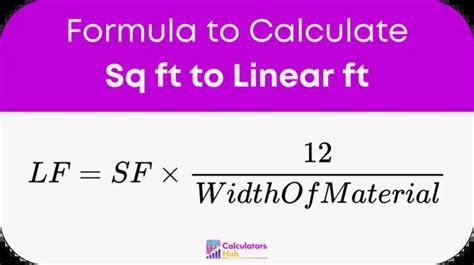
In the realm of construction and design, the nuances of measurement can often seem like a labyrinth, with each pathway leading to intricate calculations and conversions. Converting square feet to linear feet is one such measure that resembles navigating a vast landscape, where understanding one dimension can illuminate the broader expanse that it represents. Imagine square feet as a vast field—an open, unending space—while linear feet are like the winding trails that traverse through it. Each trail steps boldly into the landscape, conceding its depth to the overarching expanse beneath your feet. This relationship is not only mathematical but also tangible, revealing a unique interplay between area and length that warrants exploration.
To demystify this conversion, let us embark on an extensive journey through understanding square footage and its linear counterpart. We shall delve into definitions, applications, calculation methodologies, and relevant examples that will illuminate the connection between these two measurements. By the end of this expedition, the once elusive transformation between square feet (sqft) and linear feet (lin ft) will be crystal clear.
1. Understanding Square Feet and Linear Feet
At the outset, we must delineate the fundamentals. Square footage is a measure of area. It quantifies the size of a surface in two dimensions—length and width—forming a square or rectangle. For instance, a room measuring 10 feet by 10 feet boasts an area of 100 square feet.
Conversely, linear feet measure length only, ignoring the breadth of the space. A linear foot corresponds to a single line stretching one foot in length. For example, if you have a structure that is 10 feet long (without considering width), that measurement is expressed in linear feet.
2. The Mathematical Relationship
The relationship between square feet and linear feet is rooted in the geometry of the space being measured. To effectively convert square feet to linear feet, one must account for the width of the space. The formula can be succinctly articulated as:
Linear Feet = Square Feet ÷ Width
Here, the width must be represented in feet for the units to align appropriately. This straightforward calculation can illuminate a pathway through the often convoluted woods of measurement.
3. Practical Examples
To better understand this relationship, consider practical examples. Suppose a contractor is tasked with installing baseboards in a living room that measures 200 square feet, with dimensions of 10 feet by 20 feet. To find the linear feet of baseboard required, the calculation would proceed as follows:
- Step 1: Identify total square footage: 200 sqft
- Step 2: Identify the width of the baseboard (1 foot assumed here): 1 ft
- Step 3: Execute the conversion: 200 sqft ÷ 1 ft = 200 lin ft
Thus, the contractor will require 200 linear feet of baseboard to adequately cover the perimeter of the room. This simple yet effective calculation ties together the relationships between the two measurements, showcasing the practicality of mastering these conversions.
4. Applications in Real Life
The realms of architecture, landscaping, and even flooring installations often rely on the seamless conversion between sqft and lin ft. Whether one is laying down tiles, designing a garden, or constructing a fence, accurately converting and understanding these dimensions enable professionals and enthusiasts alike to gauge materials, labor, and costs with precision.
Imagine designing a luscious backyard oasis. When calculating the amount of sod required, one can purely measure the area. However, knowing the linear feet for borders and edges allows for enhanced aesthetics, ensuring a symphony of colors and textures harmoniously converge. The result is a space where function meets art, and measurement becomes an invisible hand guiding the transformation.
5. Implications of Miscalculations
In contrast, miscalculations in conversions could lead to misconstrued expectations, material wastage, and financial overruns. Picture a scenario where one incorrectly measures 500 square feet of tile necessary yet overlooks the width of the area needing tiles. If the understanding of linear feet is nebulous, not only will tiles be inadequately covered, but resources may also be buried beneath unintended costs and delays.
6. Tools for Conversion
In the digital age, technology facilitates accurate conversions through calculators and applications designed for construction professionals. These tools often incorporate robust algorithms, allowing for quick translations from square feet to linear feet. For those who lean towards traditional worksheets, understanding the formulas and equations becomes paramount to achieving reliable results.
Conclusion
Undoubtedly, understanding the subtle transition from square feet to linear feet is essential for those engaged in the intricate dance of design and construction. The landscape of measurements is not just about numbers; it’s a story told through lines and areas, seamlessly crafted into tangible forms. By mastering this conversion, individuals enhance their skills, allowing creativity to flourish amid accurate measurements. Embrace the path, and let your projects transform from mere concepts into realized visions, where every linear foot serves as a stepping stone across a beautifully measured expanse.








Leave a Comment