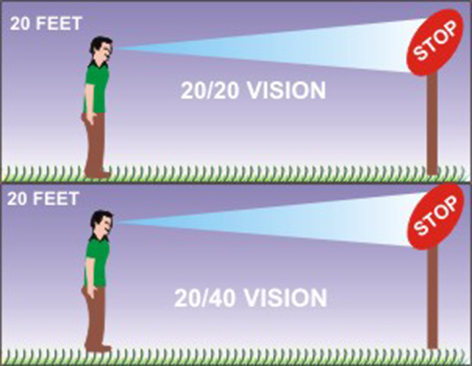
Imagine stepping outside on a radiant morning, the sun cascading through the trees, illuminating the world around you. Now, what if you could see everything in sharp detail, but with an interesting twist? This is where the notion of vision acuity enters the frame, specifically the enigma of 20/30 vision. What does it mean, and how does it challenge our perceptions of sight?
To embark on this journey, it is crucial to first decipher what 20/30 vision really signifies. Vision is quantified through a standard measurement system, which compares the vision of an individual to that of a person with ‘normal’ vision, typically defined as 20/20. In this metric, the first number indicates the distance in feet at which a person can see clearly. Conversely, the second number indicates the distance at which a person with normal vision can see the same clarity. Thus, if you possess 20/30 vision, you can see at 20 feet what a person with normal vision can see from 30 feet away. It initiates a conversation: Is this a favorable or unfavorable condition?
Understanding how 20/30 vision affects daily life is paramount. When evaluated, this level of visual acuity suggests that objects at a distance may appear somewhat less distinct. For instance, road signs might blur slightly, and faces might lack the crispness of clarity. However, it is essential to recognize that many individuals with 20/30 vision may not even realize they have a vision discrepancy, as they can comfortably navigate their environment. But what if this unnoticed issue starts to pose challenges?
Let’s delve deeper into the potential pitfalls and advantages of 20/30 vision. On one hand, individuals might find themselves excelling at close-up tasks—reading, crafting, or even engaging in intricate hobbies. The sharpness of near vision can be a hidden gem. However, as one glances toward the horizon, the panorama may not present itself with the same clarity. This becomes a challenge, especially for activities like driving, where distant objects, such as pedestrians or upcoming road signs, need to be perceived instantaneously and accurately.
Furthermore, it’s noteworthy to highlight the aspect of fluctuating visual acuity. Many individuals might experience variations in their sight due to lighting conditions, fatigue, or even health factors. For someone with 20/30 vision, this could manifest itself in moments of frustration. They might find themselves squinting; a common reflex that attempts to enhance clarity. But in the digital age, where screens dominate our lives, could there be an added layer of complexity? Our interaction with technology could exacerbate eye strain, potentially amplifying the difficulties faced by those with this level of vision. The challenge is not merely recognizing these struggles but finding effective solutions.
To address these challenges, consider the importance of regular eye examinations. Routine check-ups can unveil subtle changes that might go unnoticed. Optometrists can provide insights not just into visual acuity but also recommend corrective measures such as glasses, contact lenses, or even surgical options, depending on individual circumstances. So, how proactive are you in tracking the condition of your eyes?
Beyond corrective measures, lifestyle adjustments can serve as effective allies. The well-known ‘20-20-20 rule’—taking a 20-second break to look at something 20 feet away every 20 minutes—can be particularly beneficial in combating digital eye strain. Engaging with the landscape during these moments can provide a refreshing pause, allowing the eyes to reset. Have you considered implementing such practices into your daily routine?
Additionally, the role of nutrition cannot be understated. A diet rich in antioxidants, vitamins, and minerals, such as Vitamin A, C, E, and the omega-3 fatty acids, can support eye health dramatically. Foods like carrots, spinach, kale, and fish can enhance visual acuity over time. The connection between what we consume and our sight is an intriguing facet of overall health that is often overlooked. Are your meals working in concert with your ocular health?
In summation, the concept of 20/30 vision becomes a multifaceted dialogue about perception and clarity. While some may view it as a mild inconvenience, others may recognize it as an opportunity for improvement. The landscape of vision is not merely black and white; there lies an expansive gradient that encompasses various shades and challenges. As we traverse our daily lives, being cognizant of our vision is crucial. The question remains: Are you prepared to confront the challenge presented by your sight? By nurturing our visual health through awareness, regular check-ups, and lifestyle choices, we can strive to enhance the vividness of our world and perhaps move toward clearer horizons.







Leave a Comment