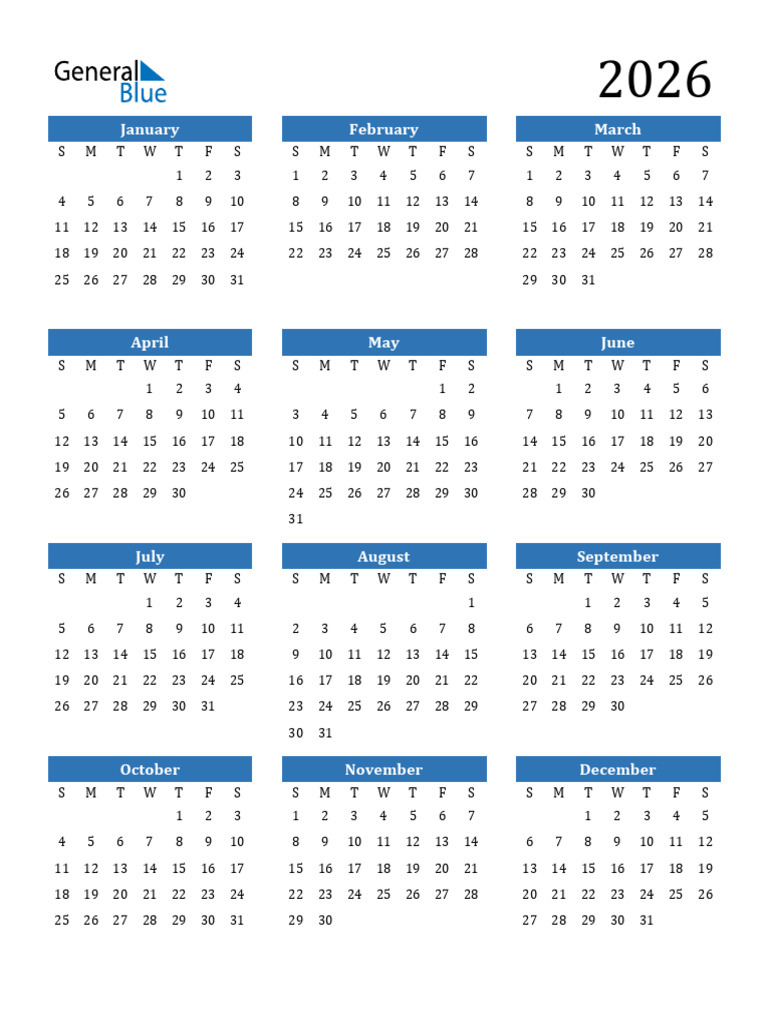
When pondering the calendar year, one might be drawn to the significance of Sundays. Each Sunday presents an opportunity for rest, reflection, and family gatherings, making it a day cherished by many. As 2026 approaches, the question arises: how many Sundays will grace this year? To arrive at the answer, we will embark on a detailed exploration, encompassing the arithmetic behind the calendar, the idiosyncrasies of specific dates, and a broader interpretation of Sundays in the context of cultural and religious observance.
To ascertain the number of Sundays in 2026, one must first recognize that this year contains 52 weeks, alongside one additional day, contributing to both regular and leap years. Given that a standard week encompasses one Sunday, basic arithmetic suggests that 2026 will include 52 Sundays. However, this figure warrants deeper investigation.
2026 is not a leap year; thus, it follows the conventional Gregorian calendar structure. Consequently, we must examine the specific days that commence and conclude the year. January 1, 2026, falls on a Thursday, inherently proposing that the first Sunday of the year is on January 4. It is noteworthy to highlight that each subsequent Sunday follows a predictable rhythm, establishing a cadence that provides insights into how this particular year unfolds.
By systematically analyzing the calendar, we find that the last day of 2026 is December 31, which is a Thursday, similar to its January counterpart. This observation emphasizes that the Sundays will persist consistently, allowing us to project their occurrence accurately throughout the year. The Sundays will thus land on the following dates:
- January 4
- January 11
- January 18
- January 25
- February 1
- February 8
- February 15
- February 22
- February 29
This is where a crucial detail emerges. While 2026 is not a leap year, those unfamiliar with leap year mechanics may momentarily be misled by the inclusion of February 29; thus, it is pertinent to clarify that February 2026 will indeed have only 28 days. Hence, the last Sunday of February will occur on the 22nd, seamlessly leading into March, which resumes the count. Continuing this cadence, the Sundays in March 2026 are as follows:
- March 1
- March 8
- March 15
- March 22
- March 29
April’s Sundays gracefully follow this established pattern, as displayed:
- April 5
- April 12
- April 19
- April 26
May echoes this rhythm with another set of Sundays:
- May 3
- May 10
- May 17
- May 24
- May 31
As we transition into the summer months, June’s Sundays fall on:
- June 7
- June 14
- June 21
- June 28
July continues the summer heat with:
- July 5
- July 12
- July 19
- July 26
August embodies a similar rhythm, showcasing:
- August 2
- August 9
- August 16
- August 23
- August 30
The arrival of September heralds the transition into fall, where Sundays appear on:
- September 6
- September 13
- September 20
- September 27
October carries forth with:
- October 4
- October 11
- October 18
- October 25
As the year draws to a close, November presents:
- November 1
- November 8
- November 15
- November 22
- November 29
Finally, December culminates with:
- December 6
- December 13
- December 20
- December 27
In totality, 2026 will lavish us with 52 Sundays. Each Sunday boasts its own potential for familial gatherings, contemplation, and spiritual observance. Whether attending church services, embarking on leisurely family excursions, or simply taking time for personal reflection, these Sundays serve as a rhythmic heartbeat within the calendar year.
As we prepare for 2026, understanding the significance of Sundays can enhance our appreciation for these intervals of respite. Mark your calendars, plan your gatherings, and relish the joy that Sundays bring to the fabric of everyday life. With 52 opportunities awaiting, 2026 stands poised to be a year rich in experiences, memories, and perhaps a few cherished Sunday traditions.









Leave a Comment