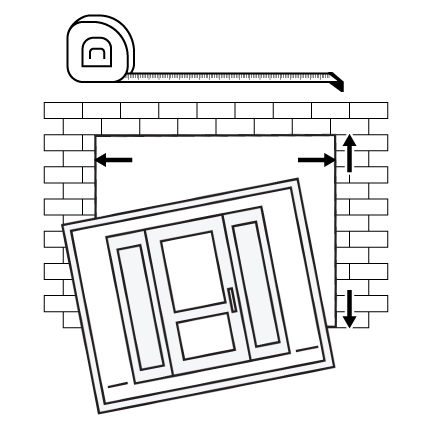
Every door frames an entryway, a silent sentinel that delineates between spaces. Whether you are embarking on a home renovation adventure or simply refreshing the aesthetics of your living space, measuring a doorway accurately is paramount. Inaccurate measurements can result in a cumbersome, ill-fitting door that neither pleases the eye nor functions properly. This guide transcends mere measurement; it invites you to embrace the art of dimensional precision. Here, we explore the steps involved in measuring a doorway for a door, ensuring that your chosen entrance is as harmonious as a well-composed symphony.
1. Gather Your Tools
Before immersing yourself in the task of measurement, arm yourself with the requisite tools. The essentials include:
- Measuring tape: A sturdy retractable measuring tape is invaluable, offering the flexibility needed to navigate various dimensions.
- Level: Ensuring your measurements are straight and true is critical; a level helps ascertain the verticality of your doorway.
- Pencil and paper: To annotate your findings meticulously.
- Square: This tool aids in checking right angles and ensuring accuracy in your measurements.
2. Exterior Width and Height Measurements
To begin, stand before the door frame, much like a painter sizing up a canvas. First, measure the width of the doorway.
- Place the end of the measuring tape at the inner edge of the frame on one side.
- Extend it to the inner edge of the opposite side, noting the width at the widest point. Record this measurement carefully.
Next, transition to the height:
- Measure from the floor to the top of the door frame, making sure your measuring tape is vertical.
- If the door frame is consistent in height, a single measurement will suffice. If there are variances, take measurements at both sides and the center.
3. Assessing Depth
Much like the depth of a well-written narrative, the depth of your doorway is equally essential. Measure the depth of the door frame:
- Locate the thickness of the side jamb, which is the vertical portion of the frame. Measure from the outer face of the jamb to the inner face where the hinge will sit.
- If the jamb has an additional overlay or trim, factor this into your measurement to ensure a snug fit.
4. Check for Squareness
An unsquared doorway can lead to misaligned doors that sag and create gaps, like punctuation errors in a published book. Using a square:
- Place one leg of the square against the side of the frame.
- Extend the other leg toward the top; if there are any disparities, your doorway may not be perfectly square.
In cases of discrepancies, adjustments may be necessary to ensure a proper fit of the new door.
5. Measure for Rail and Stile
Among door styles, rail and stile configurations add structural integrity and aesthetic grace. For those seeking a stylish addition, consider measuring:
- The width of the rail (horizontal pieces) and stile (vertical pieces) that will be visible on your chosen door.
- If you’re opting for a paneled door, record the depth of the panels to ensure they will fit within the frame while allowing for proper clearance.
6. Consider Additional Clearance
Just as an artist steps back to view the entirety of their canvas, it’s vital to account for additional clearance in your measurements:
- Doors should generally have a clearance of about 1/2 inch from the floor to accommodate mats and potential flooring irregularities.
- Also, consider the width of hinges; add a bit of additional space to avoid friction and ensure that the door swings freely.
7. Document and Confirm
With all measurements recorded, take a moment to corroborate your findings. Double-check each dimension while ensuring your notes reflect the widest points and any peculiar discrepancies. Verification is akin to proofreading; it solidifies the foundation of your undertaking.
8. Transferring Measurements to the Door Specifications
Finally, convert these measured dimensions into a detailed order for your door. Discuss specifics with your supplier to ensure that the door you select perfectly aligns with your measurements, securing an impeccable fit that transforms your space.
In conclusion, measuring a doorway for a door is more than a mere exercise in precision; it is an exploration of potential that can lead to transformative changes in your environment. Just as a master sculptor meticulously chisels away excess stone to reveal a masterpiece, so too must one approach the doorway with the same level of care and diligence. By adhering to these guidelines and utilizing your tools, you will open the gateway to a harmonious space poised for welcome and intimacy—ushering not just people, but warmth and vibrancy into your home.










Leave a Comment