
Short Answer
Main Explanation
What it is
Heaving to is a deliberate, controlled way of stopping or nearly stopping a sailboat while keeping the bow pointed at an angle to the wind and seas. The boat does not lie head-to-wind or dead downwind. Instead, it settles with the wind forward of the beam, typically 40 to 60 degrees off the bow, and fore-reaches very slowly, making slight leeway. The maneuver works by creating opposing forces: a backed headsail pushes the bow away from the wind, while the rudder, turned to weather, pushes the bow back toward the wind. The result is a dynamic balance that damps the boat’s motion and reduces speed to a crawl. In heavy weather, the same principle applies, but the sail area must be drastically reduced and the setup must be robust enough to survive hours of loading. Heaving to is not tied to any particular boat brand, sailing school, or equipment manufacturer. It is a universal seamanship technique, though its exact trim and behavior vary from boat to boat.
Why it matters
When a storm builds, thrashing to windward under too much sail is exhausting and damaging. The boat slams off waves, the crew becomes fatigued, and gear breaks. Heaving to offers a way to stabilize the boat, reduce motion, and buy time. According to Cruising Compass, heaving to is a useful technique every skipper should know, whether to wait for daylight before entering an unfamiliar harbor or to ride out heavy weather. In storm conditions, Skip Novak notes that there comes a time when continuing to windward is a useless exercise, and heaving to can put the boat into a comfortable, low-stress mode. The challenge for many sailors is that advice about heaving to is often oversimplified or conflicting. Some sources say simply tack and lash the helm; others emphasize deep reefing and careful trim. Without a clear, independent reference, a sailor may attempt the maneuver with too much sail, the wrong helm angle, or no chafe protection, and conclude that their boat cannot heave to when in fact the setup was wrong.
How it works
The mechanics of heaving to rely on three interacting elements: the backed headsail, the reefed mainsail, and the rudder. When the headsail is sheeted to windward and the boat is tacked through the wind, the headsail fills backward. This backward-filled sail pushes the bow downwind, away from the wind. At the same time, the rudder is turned hard to weather, which tries to steer the bow back up into the wind. The mainsail, deeply reefed or replaced by a storm trysail, is trimmed to balance these forces. If the main is too full or sheeted too hard, the boat may fore-reach too quickly or fall off. If the main is too flat or eased too much, the boat may stall and make excessive leeway. In heavy weather, the headsail should be a small storm jib or a deeply rolled headsail, and the main should be reefed to storm size. One critical problem identified by Cruising Compass is chafe: the windward, backed jib sheet can rub vigorously on the windward side stays and be sawn through. To prevent this, the sheet lead must be adjusted or protected. The boat’s underwater profile also matters. Moderate-displacement boats with longer keels or skeg-hung rudders often heave to more easily than very light, fin-keeled, spade-rudder designs, which may hunt or fall off. Practical Boat Owner tested four different hull designs and found that some boats heave to better with the main eased toward the quarter, confirming that there is no single universal trim.
How to do it
For a typical coastal or offshore cruising boat in sustained winds of 25 to 40 knots and building seas, the following sequence works as a starting point. First, reduce sail early. Roll the headsail down to a storm jib size or set a dedicated storm jib. Deeply reef the mainsail or set a trysail. Do not wait until the boat is overpowered. Second, choose your sea room. Heaving to causes leeway and some fore-reaching, so you need clear water downwind and to leeward. Third, from a close-hauled course, tack the boat slowly through the wind but do not release the headsail sheet. Let the headsail back against the windward side. As the bow passes through the eye of the wind, turn the helm hard to weather and lash it securely. The wheel or tiller must not be able to move. Fourth, adjust the mainsail. Ease or trim the main until the boat settles with the bow about 40 to 60 degrees off the wind and the speed drops to less than a knot. You may need to experiment: if the boat falls off too much, sheet the main in slightly or move the helm a few degrees. If the boat stalls and makes too much leeway, ease the main a touch. Fifth, check for chafe. The backed headsail sheet will bear on the windward shrouds or spreaders. Lead it through a snatch block or protect it with anti-chafe gear. Sixth, monitor the setup. In heavy seas, wave action can knock the boat out of balance. The helm lashing may need adjustment, or the headsail may need to be rolled slightly larger or smaller. Practice this maneuver in moderate conditions before you need it in a storm.

When not to do it
Heaving to is not always the right choice. If you do not have enough sea room to leeward, the slow drift may put you onto a lee shore. If your boat has a very light displacement hull, a deep fin keel, and a spade rudder, it may not settle into a stable hove-to position and may instead fore-reach too fast or fall off repeatedly. In extreme breaking seas, heaving to can leave the boat vulnerable to being rolled or pooped. In those conditions, running off under a drogue or lying to a sea anchor may be safer. Heaving to also requires a crew that understands the maneuver and can adjust trim as conditions change. If you are singlehanded and exhausted, or if the boat is already overpowered, it may be better to reduce sail further and run off. Professional training, a human weather router, or a certified marine surveyor are more appropriate when you need route-specific storm avoidance advice, a full assessment of your boat’s heavy-weather capability, or a rig inspection before an offshore passage.
Visual
The following step sequence summarizes the heaving-to procedure for a typical cruising boat in heavy weather.
- Reduce sail early. Set a storm jib or deeply rolled headsail and a deeply reefed main or trysail. The boat must be balanced and not overpowered.
- Check sea room. Ensure you have clear water to leeward and downwind for the expected drift and fore-reaching.
- Tack without releasing the headsail. Bring the bow through the wind slowly, leaving the headsail sheeted on the old windward side so it backs.
- Lash the helm to weather. Turn the wheel or tiller hard toward the wind and secure it so it cannot move.
- Trim the main to balance. Adjust the reefed main or trysail until the boat settles with the bow 40–60 degrees off the wind and speed drops below about one knot.
- Protect against chafe and monitor. Check the backed headsail sheet for chafe on shrouds, and re-check the helm lashing and trim as conditions change.
Common Mistakes
Treating heaving to as just tacking and leaving the jib aback
Many sailors learn the simplified version and then try it in heavy weather without reducing sail or adjusting the main. The consequence is an unbalanced boat that fore-reaches too fast, falls off, or loads the rig dangerously. The correct approach is to reduce sail first, then use the main and helm to find the balance point.
Using too much sail
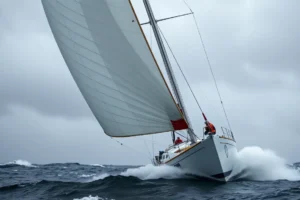
In heavy weather, a full headsail or a full main will overpower the boat and make heaving to impossible. The boat may round up, broach, or heel excessively. Always reef to storm canvas before attempting the maneuver. A deeply reefed main or trysail and a small storm jib are the standard setup.
Ignoring chafe on the windward sheet
The backed headsail sheet rubs hard on the windward shrouds and spreaders. If not protected, it can be sawn through in a matter of hours, leaving you without a headsail and out of balance. Use anti-chafe gear, lead the sheet through a block, or adjust the fairlead to keep the sheet clear of rigging.
Expecting every boat to heave to the same way
Boat design matters. A long-keel, heavy-displacement cruiser may sit quietly hove to, while a light fin-keel racer may hunt, fore-reach, or fall off. The correct approach is to practice on your own boat in moderate conditions and learn its specific trim. Do not assume that a technique that works on one boat will work identically on another.
Relying on heaving to when conditions demand a different tactic
In extreme breaking seas or when sea room is limited, heaving to may not be safe. The boat can still be rolled or driven onto a lee shore. The correct approach is to evaluate the full situation: sea state, wind trend, boat type, crew endurance, and available sea room. Running off under a drogue or lying to a sea anchor may be more appropriate.
Failing to secure the helm properly
A loosely lashed wheel or tiller can shift as the boat moves, causing the boat to fall off or round up unexpectedly. The helm must be lashed firmly to weather and checked regularly. In heavy seas, wave action can work the lashing loose, so it should be re-inspected at every watch change.
Safety Note
Heaving to is a powerful tool, but it is not a substitute for proper training, physical preparation, and human judgment. Digital references and articles like this one should complement, never replace, hands-on practice and professional instruction. Before relying on heaving to in heavy weather, practice the maneuver in moderate conditions on your own boat. Always cross-check weather forecasts, tides, and navigation data with official sources such as national weather services and coast guard broadcasts. Never use a tablet or phone as your only navigation tool; keep paper charts and a handheld GPS as backups. Ensure your storm sails, sheets, and helm lashing are in good condition and that the crew knows the procedure. Follow the International Regulations for Preventing Collisions at Sea (COLREGS) and all local maritime regulations. If you are unsure about your boat’s heavy-weather capability, have a certified marine surveyor inspect the rig and steering system before an offshore passage. Finally, take a recognized safety-at-sea course that includes heavy-weather tactics and man-overboard recovery.
FAQ
Can I heave to under bare poles?
In very strong winds, some boats can heave to under bare poles by using only the rudder and the windage of the hull and rig. However, most boats need at least a small storm jib or deeply reefed headsail to create the backed-sail force that balances the rudder. Under bare poles, the boat may lie ahull, which is a different tactic with its own risks.
How much sea room do I need to heave to?
A hove-to boat typically drifts downwind and to leeward at 1 to 2 knots. In a 12-hour period, that can be 12 to 24 nautical miles. You need enough clear water to leeward and downwind to cover that drift, plus a safety margin for wind shifts and wave action.
What if my boat won't balance when I try to heave to?
First, reduce sail further. Too much headsail or main will overpower the balance. Then adjust the helm angle slightly and try easing or trimming the main. Some fin-keel, spade-rudder boats may never settle into a stable hove-to position; in that case, consider fore-reaching under deeply reefed main alone or running off under a drogue.
Is heaving to the same as lying ahull?
No. Lying ahull means stopping the boat with no sail set and the helm lashed, letting the boat drift beam-on to the seas. Heaving to uses a backed headsail and rudder to hold the bow at an angle to the wind, which generally produces a more comfortable and controlled motion. Lying ahull can be dangerous in large breaking seas because the boat is more exposed to rolling.





Leave a Reply