
Short Answer
Recovering a crew overboard in heavy weather is one of the most demanding seamanship challenges a recreational sailor can face. Wind, waves, reduced visibility, and cold water compress the window for successful rescue and amplify the consequences of every mistake. This article explains the techniques and equipment that give a crew the best chance of getting a person back aboard safely, drawing on guidance from the RYA, Practical Boat Owner, and maritime safety research. It also shows how independent sailing reference and tools platforms can help sailors learn, plan, and practice these skills before they are needed.
Main Explanation
What it is
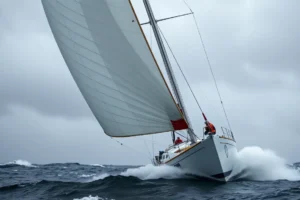
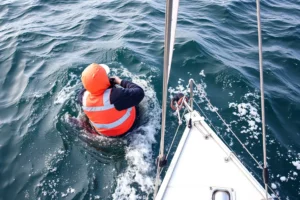
Recovering a crew overboard in heavy weather means executing a coordinated rescue when wind and sea state make boat handling, spotting, and retrieval significantly harder than in calm conditions. It is not a single maneuver but a system with five linked phases: prevention, immediate response, returning to the person, making contact, and reboarding. In Force 6 or above, each phase becomes more difficult. The boat may be heeled hard, the person in the water disappears between wave crests, and the crew must manage sails, engine, and safety gear under high stress.
In the context of independent sailing reference and tools platforms, this topic is a core seamanship module. Such platforms organize boat-agnostic knowledge—techniques, equipment choices, decision flows, and checklists—so that sailors can study and practice before an emergency. They are not tied to a specific boat brand, sailing school, or equipment manufacturer. Instead, they compile established guidance from national sailing federations, coast guard authorities, and experienced practitioners into a structured, searchable reference.
Why it matters
The stakes are extremely high. Research by the UK Maritime Accident Investigation Branch (MAIB), cited by the RYA, shows that crews have on average less than 11 minutes to recover a crewmate who has fallen into cold water before the victim becomes unresponsive. In colder water or rougher seas, that window can shrink to just four or five minutes. More than 40% of man overboard occurrences reported to the MAIB between 2015 and 2023 led to a fatality. Drowning accounts for 76% of all recreational boating deaths, and 87% of drowning victims were not wearing a personal flotation device.

Beyond the raw numbers, sailors face a practical problem: information overload. Online forums, outdated textbooks, manufacturer manuals, and anecdotal advice often conflict. A technique that works in a flat-water drill may fail in breaking seas. Without a reliable, independent reference, a crew can waste precious minutes debating what to do. Heavy weather also reduces visibility, makes boat control harder, and increases the risk of a second person going overboard during the rescue attempt. A structured, evidence-based approach is not a luxury—it is a survival tool.
How it works
Independent sailing reference and tools platforms typically structure heavy weather crew overboard recovery around four key areas:
- Boat knowledge and reference: Understanding your vessel’s freeboard, boarding points, stability characteristics, and existing MOB equipment. A high-freeboard cruising boat may need a different retrieval method than a low-freeboard daysailer.
- Seamanship education: Step-by-step explanations of proven maneuvers such as the hove-to approach, quick stop, and figure-eight turn under sail, plus the Williamson and Anderson turns under power. These are presented with diagrams, videos, and decision trees.
- Passage planning tools: Integrating weather forecasts, sea state predictions, and route planning so that crews can anticipate heavy weather and reduce the likelihood of a MOB in the first place. This includes identifying safe harbors, timing passages, and setting conservative crew policies.
- Decision-support features: Checklists, flowcharts, and emergency action plans that guide a crew through the first 60 seconds after a MOB. These tools help assign roles, deploy flotation, mark the position, and choose the correct turn based on conditions and boat type.
In practice, a sailor might use the platform to review the hove-to approach before a passage, print a laminated MOB checklist for the cockpit, and then run a crew briefing that assigns each person a specific job: spotter, helm, flotation thrower, and radio operator.
How to do it
Consider a typical scenario: planning a coastal passage with a forecast of Force 6 winds and a choppy sea. A practical walkthrough using an independent reference platform would look like this:
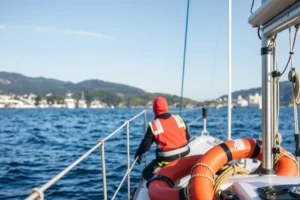
- Assess the boat and crew. Review the vessel’s freeboard, boarding ladder, and MOB equipment. Confirm that all crew have properly fitted PFDs with crotch straps, lights, and whistles. Check that jacklines and tethers are rigged and that everyone knows how to clip on.
- Study the techniques. Read the platform’s guidance on heavy weather MOB recovery. Focus on the hove-to approach, which can keep the boat near the casualty while reducing violent motion, and the quick stop, which minimizes distance from the person. Watch any available videos and note the key differences from calm-water drills.
- Practice in moderate conditions first. Before facing Force 6, run MOB drills in 10–15 knots. Use a fender or dummy. Time the maneuver, practice throwing a Lifesling, and rehearse the reboarding method. The goal is muscle memory, not perfection.
- Create a crew briefing. Use the platform’s checklist to assign roles. The spotter never takes eyes off the person. The helm initiates the turn. One crew member prepares the throwable flotation and Lifesling. Another handles the VHF radio and GPS MOB button.
- Cross-check weather and tides. Before departure, verify the forecast with an official national weather service. Recheck it at least every few hours. Heavy weather can build quickly, and a MOB is far less likely if the crew has already reduced sail, reefed, or altered course.
- Identify decision points. Agree in advance on when to call for outside help, when to start the engine, and when to abandon a particular retrieval method if it is not working. In heavy weather, a failed first attempt may require a different approach, not a repeat of the same mistake.
When not to do it
An independent reference platform is a powerful learning and planning tool, but it has clear limits. It should not be your only source of information in a real emergency. When the person is in the water and the boat is being thrown around by waves, you do not have time to scroll through a tablet. The platform’s value is in preparation, not real-time decision-making.
Do not rely solely on a digital reference for hands-on skills. A certified sailing school or safety-at-sea course provides supervised practice, instructor feedback, and stress inoculation that no website can replicate. Similarly, a human weather router or professional forecaster is more appropriate for complex offshore passages where local effects and rapidly changing systems require expert interpretation. If you need to evaluate your boat’s stability, rigging, or MOB retrieval hardware, a certified marine surveyor or naval architect should be consulted. Finally, never use a digital platform as a substitute for official navigation data, VHF radio procedures, or compliance with COLREGS and local maritime regulations.
Visual
The table below compares common sources of information on heavy weather crew overboard recovery. It shows where an independent digital reference platform fits among traditional textbooks, manufacturer manuals, sailing school courses, and online forums.
| Source | Strengths | Limitations | Best For |
|---|---|---|---|
| Traditional textbooks | In-depth, structured, peer-reviewed; good for fundamentals | Can be outdated; not interactive; may not cover modern equipment | Building a theoretical foundation |
| Manufacturer manuals | Boat-specific details on hardware and systems | Narrow focus; no seamanship context; may promote brand solutions | Understanding your own boat’s equipment |
| Sailing school courses | Hands-on practice, instructor feedback, realistic drills | Costly, time-limited, not always available; skills fade without practice | Developing muscle memory and confidence |
| Online forums | Real-world anecdotes, quick answers, diverse experience | Conflicting advice, no quality control, often lacks context | Generating ideas, but not as a primary source |
| Independent digital reference platforms | Structured, searchable, boat-agnostic, regularly updated, combines text, diagrams, and checklists | Cannot replace hands-on training; requires self-discipline to study and practice | Pre-passage planning, crew briefing, and skill review |
Common Mistakes
Over-reliance on a single source
Some sailors learn one MOB turn from a YouTube video and assume it will work in all conditions. In heavy weather, a maneuver that works in flat water may be impossible or dangerous. The consequence is wasted time and a failed rescue. The correct approach is to study multiple proven techniques, understand their assumptions, and practice the one best suited to your boat and conditions.
Ignoring weather updates after planning
A crew may check the forecast before departure and then never look again. Heavy weather can develop quickly, and a MOB is far more likely if the boat is over-canvassed or caught off guard. The consequence is that the crew faces a rescue in conditions they did not anticipate. The correct approach is to recheck official weather sources at regular intervals and adjust sail plan, course, or timing accordingly.
Using generic checklists without adapting them to the boat
A checklist that says ‘deploy the Lifesling’ is useless if the Lifesling is buried in a locker or the crew does not know how to rig it. The consequence is delay and confusion during the emergency. The correct approach is to customize every checklist to your specific boat, equipment locations, and crew roles, and to rehearse it until it becomes automatic.
Confusing reference material with real-time data
A digital platform may show a recommended turn or a weather routing example, but it does not know your current position, sea state, or the exact position of the person in the water. The consequence is that a sailor may follow a static diagram instead of responding to the actual situation. The correct approach is to use the platform for preparation, but in the moment rely on your eyes, your instruments, and your trained crew.
Practicing only in calm conditions
Many crews run MOB drills on a sunny afternoon with flat water and then believe they are prepared. In Force 6, the boat behaves differently, the person is harder to see, and the retrieval is far more physical. The consequence is a false sense of competence. The correct approach is to practice in progressively stronger winds, even if only with a fender, and to include the reboarding step, not just the turn.
Neglecting prevention and assuming recovery will work
The best MOB recovery is the one that never happens. Sailors who focus only on retrieval techniques may overlook the importance of tethers, jacklines, high-side movement, and staying in the cockpit. The consequence is that a preventable fall becomes a life-threatening emergency. The correct approach is to treat prevention as the first phase of recovery: brief the crew, clip on before leaving the cockpit, and reduce sail early in heavy weather.
Safety Note
Digital reference platforms and similar tools are valuable for learning and planning, but they must fit into a broader safety framework. They complement—never replace—proper training, physical checks, and human judgment. Before relying on any MOB recovery plan, take a certified safety-at-sea course that includes in-water practice. Always cross-check critical data such as weather, tides, and navigation with official sources: national weather services, coast guard broadcasts, and up-to-date paper or electronic charts. Never use a tablet or phone as your only navigation tool; carry paper backups and a handheld VHF radio. Follow COLREGS and local maritime regulations at all times. In heavy weather, the most important decision is often to avoid the situation entirely: reef early, clip on, and keep the crew in the cockpit. If someone does go overboard, the first 60 seconds determine the outcome. Shout ‘crew overboard,’ assign a spotter, throw flotation, press the MOB button on your GPS, and initiate a controlled turn. Then execute the plan you have already practiced—not the one you are reading for the first time.
FAQ
What is the first action when someone goes overboard in heavy weather?
Shout 'crew overboard' loudly, assign a dedicated spotter who never takes eyes off the person, throw flotation immediately, press the MOB button on your GPS, and initiate a controlled turn while keeping the boat under control. Do not lose sight of the person.
Which MOB turn is best in heavy weather?
There is no single best turn for all boats and conditions. For sailing vessels, the hove-to approach can keep the boat near the casualty while reducing motion, and the quick stop minimizes distance. Under power, the Williamson or Anderson turn may be appropriate. The best maneuver is the one your crew has practiced and that suits your boat's handling in the actual sea state.
How long do you have to recover someone in cold water?
On average, less than 11 minutes before the victim becomes unresponsive. In very cold water or rough seas, the window can be as short as 4–5 minutes. This is why immediate flotation, a spotter, and a well-rehearsed plan are critical.
Can a digital reference platform replace hands-on MOB training?
No. A digital platform is excellent for learning techniques, planning passages, and creating checklists, but it cannot replicate the physical skills, stress inoculation, and instructor feedback of a certified safety-at-sea course. Use the platform to prepare, then practice on the water.






Leave a Reply