
Short Answer
A person falling overboard is one of the most serious emergencies a recreational sailor can face. The difference between a controlled rescue and a tragedy often comes down to whether the crew has practiced a man overboard (MOB) drill before the emergency happens. This guide breaks the procedure into clear, repeatable steps based on established practices from organizations such as US Sailing, powerboat training providers, and boater education programs. It is written as an independent reference, not tied to any specific boat brand, sailing school, or equipment manufacturer, so the core principles apply across sailboats, powerboats, and RIBs.
Main Explanation
What it is
A man overboard drill is a structured, rehearsed sequence of actions that begins the moment someone falls into the water and ends when that person is safely back on board. The procedure is generally divided into three stages: initial reaction on board, turning the boat around and returning to the person in the water, and approaching and recovering the casualty. As an independent sailing reference, this guide consolidates the common elements from multiple recognized procedures rather than promoting a single school’s method. That means the steps are adaptable to different vessel types, crew sizes, and conditions, but they always prioritize the same core objectives: keep the person in sight, provide flotation, stop the boat safely, and return without causing further harm.
Why it matters
Recreational sailors face a real problem when learning emergency procedures: information overload, conflicting advice, and outdated resources. A quick online search can return dozens of variations for the same maneuver, some written for racing crews, others for single-handed sailors, and many that assume equipment or crew numbers you may not have. The stakes are high. Cold water can incapacitate a person within minutes, a spinning propeller can cause catastrophic injury, and losing visual contact with a person in the water is one of the fastest ways to turn a rescue into a recovery. A reliable, independent reference helps cut through the noise by focusing on the non-negotiable steps that appear across authoritative sources, while leaving room for boat-specific adaptation.
How it works
The man overboard drill works as a three-stage system. The first stage is initial reaction: shout “man overboard,” assign a dedicated spotter, throw buoyant flotation toward the person, and stop the boat’s engine or depower the sails. The second stage is the return maneuver. For powerboats, this often means a controlled turn such as a Williamson turn or a simple U-turn after the boat has slowed. For sailboats, common options include the quick stop, figure-eight, or deep-beam reach return. The third stage is recovery, which depends on the boat’s freeboard, the person’s condition, and available equipment such as a boarding ladder, lifting sling, or parbuckle. Throughout all three stages, the spotter must never take their eyes off the person in the water, and the helmsperson must balance speed with control to avoid creating a second emergency.

How to do it
Here is a practical walkthrough for a typical coastal passage scenario with at least two people on board. First, the moment someone goes overboard, shout “man overboard” loudly and point at the person. Do not turn the boat sharply toward them immediately; instead, reduce speed and continue straight ahead briefly to move the propeller and stern away from the casualty. Assign one crew member as the spotter, whose only job is to keep eyes on the person and point continuously. Throw a throwable flotation device, life ring, or any buoyant object toward the person, and if possible, litter the water with additional floating items to mark the location. Stop the engine or depower the sails. If you have a GPS or chartplotter, mark the position immediately. Then execute your practiced return maneuver, approaching the person from downwind or down-current so the boat does not drift over them. Once alongside, stop the boat completely, secure the engine in neutral, and use your recovery equipment to bring the person aboard. Finally, provide first aid, treat for hypothermia, and contact emergency services if needed.
When not to do it
A written guide, no matter how clear, is not a substitute for hands-on practice. You should not rely solely on a step-by-step reference the first time you face a real man overboard emergency. Professional on-water training with a certified instructor is essential for learning the feel of the maneuvers and for practicing recovery in controlled conditions. Similarly, a reference guide cannot evaluate your specific boat’s handling characteristics, freeboard, or equipment layout; a certified marine surveyor or experienced captain is more appropriate for that assessment. For complex offshore passages, a human weather router or professional passage planner provides judgment that no static reference can replace. And in real time, always cross-check navigation, weather, and tide data with official sources rather than relying on a single app or document.
Visual
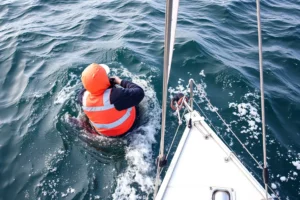
The following step sequence summarizes the man overboard drill from the moment of the fall to recovery. Use it as a quick-reference checklist during practice sessions.
- Shout and point: Yell “man overboard” and physically point at the person in the water.
- Assign a spotter: One crew member keeps eyes on the casualty at all times and does nothing else.
- Throw flotation: Immediately throw a life ring, throwable cushion, or any buoyant object toward the person.
- Stop the boat: Reduce speed, stop the engine or depower sails, and avoid turning sharply toward the casualty.
- Mark position: Note the location on GPS or chartplotter, and litter the water with floating objects if possible.
- Execute return maneuver: Use a practiced turn appropriate for your vessel type and conditions.
- Approach safely: Come alongside from downwind or down-current, stop the boat, and put the engine in neutral.
- Recover the person: Use a boarding ladder, lifting sling, or parbuckle to bring the casualty aboard, then provide first aid.
Common Mistakes
Turning sharply toward the casualty immediately
The instinct to turn the boat around as fast as possible is dangerous. A sharp turn can swing the stern and propeller toward the person in the water, creating a risk of severe injury. The correct approach is to reduce speed first, continue straight ahead briefly, and then execute a controlled return maneuver.
Failing to assign a dedicated spotter
In the chaos of an emergency, it is easy for everyone to start doing different tasks and lose sight of the person in the water. Without a dedicated spotter, the casualty can disappear behind waves or in poor light within seconds. One person must be assigned to point at the person and never look away until the boat is alongside.
Not throwing flotation early enough
Every second counts in cold water. Delaying the throw of a life ring or buoyant cushion while you sort out the boat reduces the person’s chance of staying afloat and visible. Throw flotation immediately, even before you stop the boat, and throw additional floating objects to mark the location.
Using a generic checklist without adapting it to your boat
A man overboard procedure written for a 40-foot sailboat with a full crew may not work on a 20-foot powerboat with two people. Recovery methods, turning radius, freeboard, and equipment all vary. Practice the drill on your own boat and adapt the steps to your specific layout, crew size, and available gear.
Confusing reference material with real-time conditions
A step-by-step guide tells you what to do in principle, but it cannot tell you what the wind, current, sea state, or visibility are doing right now. Always assess the actual conditions before executing a maneuver. A return approach that works in calm water may be unsafe in breaking seas or strong current.
Neglecting to practice the drill regularly
Reading about a man overboard drill is not the same as performing it. Skills degrade without practice, and the stress of a real emergency makes even simple tasks harder. Schedule regular on-water drills with your crew, including at least one drill in conditions that are less than ideal, so the procedure becomes muscle memory.
Safety Note
A man overboard drill is only one part of a broader safety framework. Digital tools, written guides, and reference platforms complement proper training, physical checks, and human judgment; they never replace them. Always cross-check critical data such as weather, tides, and navigation with official sources like national weather services, coast guard broadcasts, and updated paper charts. Never use a tablet or phone as your only navigation tool, and keep paper backups on board. Take a certified safety and sea survival course from a recognized organization such as US Sailing, the RYA, or your national sailing federation. Practice the drill with your actual crew and equipment, and ensure everyone knows how to use the lifejackets, throwable devices, and recovery gear on your specific boat. Finally, always follow the International Regulations for Preventing Collisions at Sea (COLREGS) and local maritime regulations when maneuvering during a rescue, and maintain a proper lookout at all times.
FAQ
What is the very first thing to do when someone falls overboard?
Shout "man overboard" loudly, point at the person, and assign a dedicated spotter to keep eyes on them at all times. Then throw a buoyant flotation device toward the person and stop the boat's engine or depower the sails.
How often should we practice a man overboard drill?
At least once per season, but more often if you sail with new crew or in challenging conditions. Regular practice builds muscle memory and helps you adapt the procedure to your specific boat and equipment.
What if I am single-handed and someone falls overboard?
Single-handed recovery is extremely difficult. The priority is to throw flotation, mark the position on GPS, and keep the person in sight while executing a return maneuver. Practice a solo MOB drill in calm conditions with a fender or dummy before relying on it in an emergency.
What is the best recovery method for a powerboat?
For most powerboats, a controlled turn after slowing down, followed by an approach from downwind or down-current, works well. Recovery often uses a transom ladder or lifting sling. The exact method depends on freeboard and available equipment, so practice on your own boat.







Leave a Reply