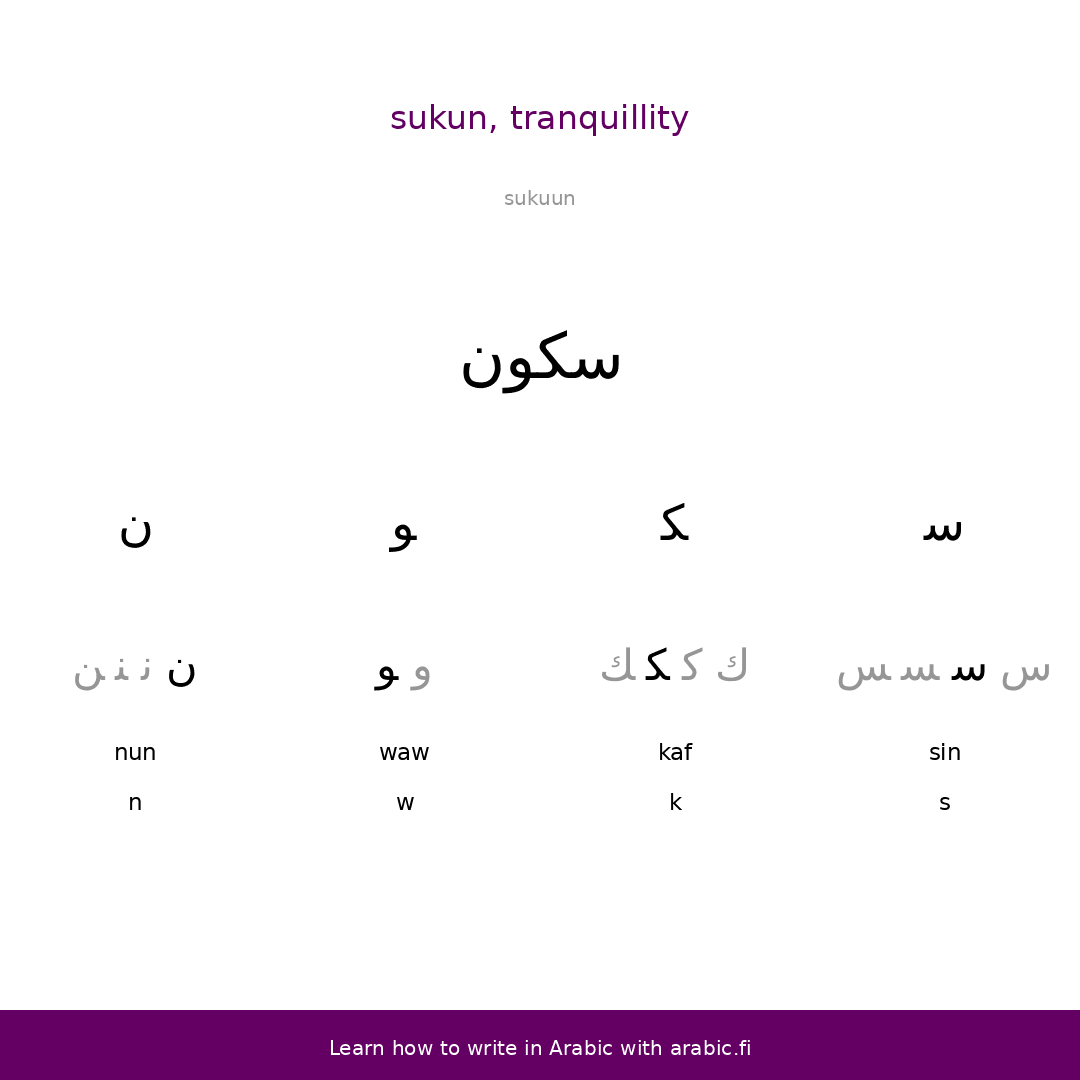
Understanding the Alif Sukoon and its applications is an intrinsic part of mastering the Arabic language. The Arabic script is an illustrious tapestry woven from intricate letters and diacritics, each contributing uniquely to the overall linguistic structure. The Alif Sukoon stands out not just for its form but for its functional significance. This article will delve into the multifaceted aspects of Alif Sukoon, providing readers with a comprehensive understanding of its use, phonetics, variations, and more.
1. Introduction to Alif Sukoon
At its essence, Alif Sukoon is a foundational element within the Arabic alphabet. The Alif letter (ا) serves as a vowel carrier, often representing a long ‘a’ sound. However, when accompanied by a Sukoon (ة), which is a diacritical mark indicating the absence of a vowel, it transforms into a pivotal marker that alters its phonetic resonance. This peculiar combination allows for nuanced articulation, thus enhancing lexical diversity in the Arabic language.
2. Phonetic Characteristics
The juxtaposition of Alif with Sukoon presents a unique challenge for learners. In essence, Alif Sukoon denotes a space to pause or create a break between phonetic expressions, a significant aspect in Arabic prosody. Arabic is characterized by its rich consonantal framework, and the usage of Sukoon allows readers and speakers to navigate through varied phonetic landscapes seamlessly. Notably, pronunciations become distinct, as the Sukoon modifies how Alif interacts with neighboring letters.
3. Illustrating Form and Function
To grasp the full spectrum of Alif Sukoon, it helps to see it in context. For instance, the word مَكْتُوب (maktub) features the Alif Sukoon as a crucial component. Here, the letter Alif accentuates the elongation of the preceding sounds while the Sukoon stabilizes the following consonant. This symbiosis exemplifies how nuanced relationships between letters can dictate the means of pronunciation and convey meaning.
4. Variations and Contextual Use
The versatility of Alif Sukoon is further expressed in its variations across different dialects. For example, dialectal differences may alter the significance or pronunciation of the word containing Alif Sukoon. Additionally, Alif can appear in various forms, such as Alif Madda (آ) which accentuates prolonged sound, thereby emphasizing a distinguished phonetic expression. Recognizing these variations allows learners to appreciate regional nuances and cultural richness inherent in Arabic communication.
5. Grammatical Significance
In Arabic grammar, the presence of Alif Sukoon can also impact meaning on a syntactic level. It plays a role in the constructions of words, particularly in verb forms and noun constructs. The incorporation of Alif with a Sukoon is frequently observed in the conjugation of verbs, where its placement can signal tense or plurality. Understanding this grammatical significance equips learners with the tools necessary for advanced language comprehension.
6. Learner Challenges and Strategies
While mastering Alif Sukoon, students often encounter challenges related to pronunciation and application. Some may struggle to articulate the specific transitions prompted by the Sukoon. To overcome these hurdles, educators recommend auditory learning techniques, where learners are exposed to native pronunciation through listening exercises. Additionally, practice through interactive dialogues and phonetic drills can reinforce the mastery of Alif Sukoon in everyday usage.
7. Practical Applications in Daily Language
Alif Sukoon is frequently utilized in day-to-day Arabic conversations, written communication, poetry, and literature. Its omnipresence in common expressions signifies its importance and the need to incorporate it into one’s lexical repertoire. By utilizing phrases such as صَدِيقٌ (sadiq), where the Sukoon marks a pause, learners can appreciate the rhythm and flow of the Arabic language in practical settings.
8. Cultural Significance
Beyond grammatical and phonetic applications, Alif Sukoon bears cultural resonance within Arabic literature and poetry. Many poets and authors employ Alif Sukoon to create meter and rhythm in their works, showcasing a profound connection between language and artistic expression. The breath-taking beauty of Arabic poetry often hinges on such subtle nuances, allowing readers to appreciate not only the language but the culture it enriches.
9. Summary of Key Points
In summary, the Alif Sukoon is a complex yet essential element of the Arabic alphabet that warrants thorough exploration. Its phonetic attributes, structural implications, and cultural significance must be understood holistically, allowing learners to engage deeply with the language. Acknowledging its variations, recognizing its grammatical roles, and applying it in everyday contexts enhance one’s proficiency and appreciation for Arabic.
10. Conclusion
The exploration of Alif Sukoon reveals how even the smallest components of a language can wield substantial influence over sound, meaning, and cultural expression. Embracing its intricacies not only improves linguistic capability but also enriches one’s understanding of the Arabic literary and spiritual heritage. Thus, as learners navigate through the fascinating labyrinth of the Arabic script, Alif Sukoon stands as a beacon guiding the way toward mastery.











Leave a Comment