In the realm of electrical engineering and power management, understanding the relationship between amp hours (Ah) and watt hours (Wh) is paramount. These two units, while fundamentally distinct, are intricately connected, much like the threads of a tapestry. To demystify this connection, one must embark on a journey through the realm of electricity, exploring these units’ definitions, their calculations, and their practical applications. This exploration promises not just clarity, but a fresh perspective on power consumption and battery efficiency.
At the core of our discussion lies the definitions of amp hours and watt hours. Amp hours measure electrical charge over time. Specifically, it quantifies the total charge a battery can deliver over a one-hour period at a given current, measured in amperes. For instance, a battery rated at 10 Ah can theoretically provide a current of 10 amperes for one hour or 1 ampere for 10 hours. On the other hand, watt hours measure the total energy consumed or produced over time. It factors in both the current and the voltage (measured in volts), encapsulating energy more holistically.
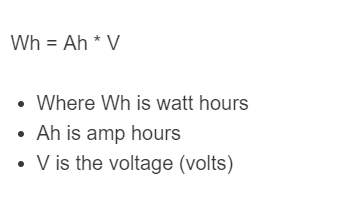
To pique curiosity, consider this: how can these seemingly disparate measurements coexist in a coherent framework? The answer lies in the mathematical conversion between them. The conversion from amp hours to watt hours is straightforward, governed by the equation:
Watt Hours (Wh) = Amp Hours (Ah) × Volts (V)
This formula invites exploration of individual components. The amp hour, as we previously mentioned, signifies current capacity, while voltage represents the potential difference that drives the current through a circuit. Understanding voltage nuances is vital, as different devices operate under varying voltage levels, impacting energy calculations. Imagine a landscape dotted with devices, each governed by its unique voltage requirements, all contributing to the narrative of power consumption.
By applying this equation, one can appreciate the interconnectedness of these two units. For example, if one has a battery rated at 12 Ah and a voltage of 12 volts, the energy stored in that battery can be calculated as:
12 Ah × 12 V = 144 Wh
An understanding of this relationship allows individuals and technicians alike to evaluate battery performance and efficiency critically. However, delving deeper reveals additional considerations needed for making informed decisions regarding energy use and battery selection.
Another significant aspect to consider is the implications of load and discharge rates. Batteries are not just about their stated amp hour ratings; their performance can vary dramatically under different conditions. For instance, discharging a battery at high currents can lead to inefficiencies due to heat generation, voltage drops, and reduced capacity. This draws attention to the concept of “C-rate,” which refers to the rate at which a battery is charged and discharged relative to its capacity. Higher discharge rates may yield shorter usable durations, thus complicating the relationships established between amp hours and watt hours.
Furthermore, battery chemistry plays an essential role in performance. Lithium-ion, lead-acid, and nickel-metal hydride batteries all behave differently when subjected to load and temperature variations, affecting both their voltage and overall discharge capacity. One must recognize that a battery’s amp hour rating is often an idealized number, influenced heavily by the specifics of the application and load conditions. Consequently, discrepancies between theoretical calculations and real-world performance may arise, sparking the need for a nuanced understanding of battery metrics.
In practical applications, the awareness of how to convert amp hours to watt hours, and vice versa, has concrete implications. For instance, solar energy systems, electric vehicles, and portable electronics all hinge on the careful manipulation of these values to maximize efficiency and runtime. Such systems integrate not just raw calculations but also sophisticated algorithms that dynamically adapt to operational changes, enhancing overall system performance.
Coupled with the burgeoning rise of renewable energy and electric mobility, grasping the amp hour to watt hour conversion fosters innovative solutions for sustainable energy use. When determining battery requirements for renewable energy storage, for instance, understanding the watt hours is crucial. If a solar setup delivers 500 watts and one seeks to maintain power for 5 hours, it will require a battery that can provide:
500 W × 5 h = 2500 Wh
Subsequently, converting that to amp hours requires knowledge of the system’s voltage. If the battery operates at 12 volts, the required amp hours become:
2500 Wh ÷ 12 V ≈ 208.33 Ah
Such calculations empower users to design systems that meet specific energy demands, facilitating a transition to greener technologies and energy independence.
In conclusion, the interplay between amp hours and watt hours transcends mere equations; it encapsulates the very essence of power management and energy utilization. Understanding this dynamic not only equips individuals with the knowledge to evaluate the efficacy of batteries but also unlocks new avenues for innovative energy solutions. As the world pivots towards sustainable practices, fostering a robust comprehension of these electrical metrics is no longer optional—it’s essential for anyone engaged in the energy landscape.










Leave a Comment