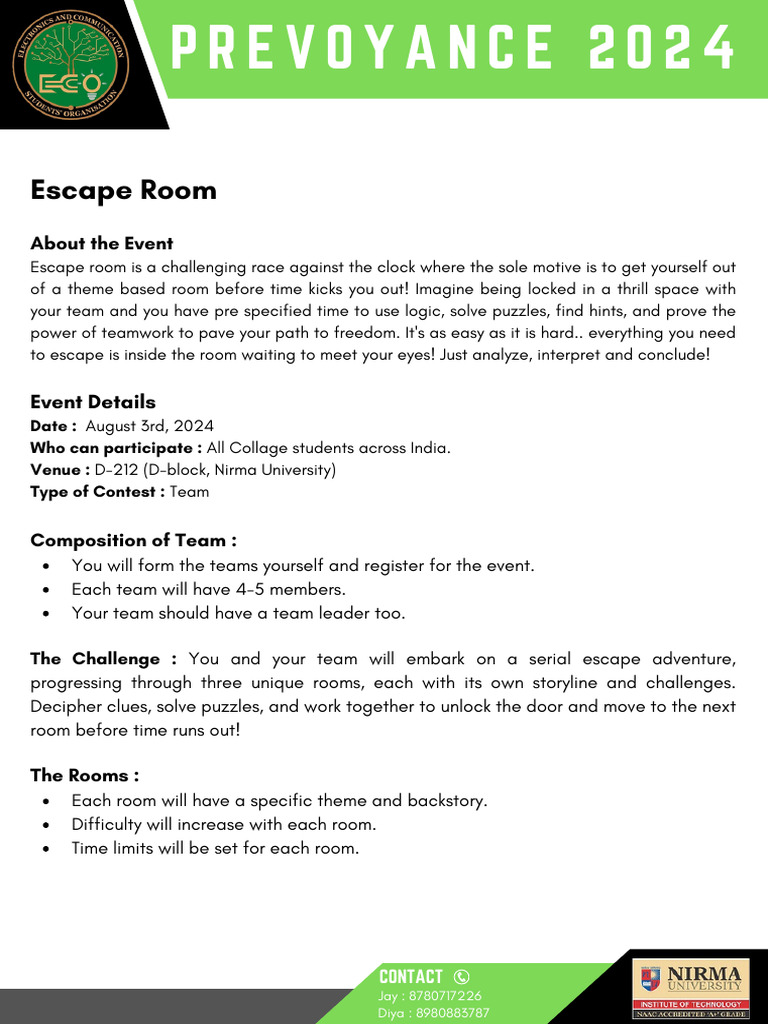
Imagine being locked in a room with your closest friends, colleagues, or family, with only 60 minutes on the clock to solve a series of intricate puzzles, decode cryptic messages, and ultimately escape. Escape rooms have surged in popularity, offering an exhilarating blend of teamwork, adventure, and mental acuity. But as you start planning your thrilling escapade, a question looms large: how many people do you need for an escape room experience? This inquiry is more than mere logistics; it poses a playful challenge that can significantly influence the enjoyment and effectiveness of the escapade.
The answer to our question largely depends on multiple factors: the size of the escape room, the intricacy of the puzzles, and the demographics of your group, including their age and experience level. Let’s delve deeper into each of these components to unravel the optimal number of participants to enhance your escape room adventure.
1. Consider the Room Size
First and foremost, escape rooms vary in size. Some are spacious, accommodating up to ten or more players, while others are more intimate, designed for a handful of participants, commonly ranging from two to six players. The room’s dimensions directly influence how many people can actively participate without feeling cramped or overwhelmed. When you’re crammed together, it may breed chaos rather than collaboration, impeding effective communication.
A general rule of thumb for room size is the “one player per 100 square feet” guideline. If your escape room is around 200 square feet, aiming for two to four players might be ideal, ensuring all participants can easily move around, access clues, and interact with each other without stepping on toes—quite literally!
2. Assess Puzzle Complexity
Next, the complexity of the puzzles in the escape room is paramount. A room with intricate riddles and multilayered puzzles may necessitate a larger group to tackle the various challenges effectively. Conversely, simpler puzzles might be better suited for smaller gatherings. If everyone in your group is an escape room aficionado, consider a more challenging experience that can still be tackled by a select few.
Another facet to consider is the availability of space for puzzle-solving. A large group in a room filled with complex puzzles can cause a bottleneck effect, where players have to wait their turn to interact with clues. Therefore, groups of four to six often strike a desirable balance between diverse problem-solving skills and managing the flow of activity throughout the room.
3. Evaluate Player Skills
Skill levels within the group can heavily influence the optimal group size. If your team comprises seasoned escapists, they may thrive in a smaller group, channeling their expertise into a cohesive escape strategy. In contrast, if you’re joining forces with novices or casual players, a larger team might bolster confidence and enhance collaborative spirit, enabling less experienced participants to learn from their more adept counterparts.
Moreover, diversity in skill sets can be immensely beneficial. A balanced group that includes puzzle solvers, lateral thinkers, and those adept at spatial reasoning can elevate the escape room experience. Consider including individuals with specific talents—like a knack for mathematics, code-breaking, or lateral thinking—to create a more enriching environment, inevitably leading to a more successful escape.
4. Personal Preferences and Group Dynamics
Individual preferences and dynamics can also play a significant role in determining the ideal headcount for your escape room venture. Consider what type of atmosphere you aim to cultivate. Do you favor intimate gatherings that allow for personal connections? Perhaps you desire an exciting, loud experience that typically accompanies larger groups.
The chemistry among players is equally crucial. A cohesive team that communicates effectively will likely thrive regardless of size. However, if interpersonal conflicts exist or if the group’s dynamics are tenuous, even a small party could become chaotic, leading to frustration instead of harmony. Thus, understanding the personalities of your group members is critical when making your decision.
5. Overall Experience and Goals
Finally, reflect on what you hope to achieve from the escape room experience. Are you there solely for entertainment? Or is it a bonding activity aimed at strengthening team dynamics? For purely recreational purposes, either small or large groups can work effectively, with larger crowds amplifying the excitement. However, if you are aiming for team-building or cooperation skills, smaller groups might foster more intimate communication and collaboration.
In summary, while there is no one-size-fits-all answer to the conundrum of how many people you need for an escape room, several factors merit your consideration. Weigh the room’s size, puzzle complexity, player skills, personal dynamics, and your intended experience against each other to determine the ideal group size. The beauty of an escape room adventure lies not only in escaping but in the shared journey—so gather your team wisely. Will it be an epic quest with a dozen adventurers, or a strategic challenge elegantly executed with a close-knit group of four? The choice is yours to make. Whatever the decision, prepare for an unforgettable escapade that will have you laughing, thinking, and possibly even bonding more than you ever anticipated.










Leave a Comment