The practice of prayer in Islam, known as Salah, is not merely a ritual but rather a profound journey toward spiritual elevation. Among the five daily prayers, Isha stands out, embodying a transition from daylight to evening, a passage that reverberates with tranquility and introspection. In this exploration of Isha, we delve into its essence, focusing on the number of rakats associated with this prayer and its significance within the broader framework of Islamic worship.
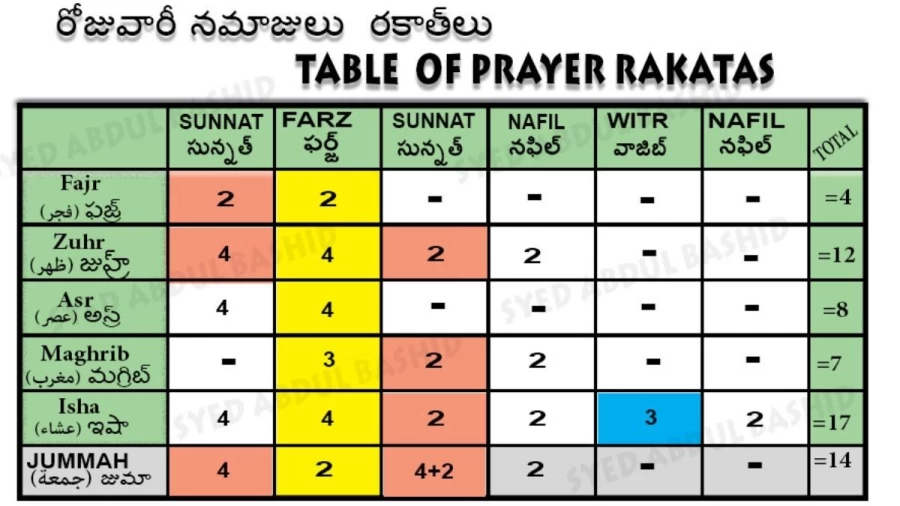
The Isha prayer, like the serene twilight that envelops the world after the sun has set, consists of a total of 17 rakats. This number is not arbitrary; it serves as a structure for the spiritual journey undertaken during this time. The rakats are divided into obligatory and voluntary components, each playing a vital role in shaping the experience of worship.
To begin, the obligatory prayers, or fard, form the spine of the Isha prayer. Consisting of 4 rakats, these are performed with a sense of solemnity and purpose. They are akin to the main pillars of a grand edifice, steadfast and essential. In these rakats, the soul engages in communion with the Divine, reciting verses from the Qur’an and embodying the humility that prayer demands. With each movement—from standing in qiyam to bowing in ruku and prostrating in sujud—the faithful embody a physical manifestation of their devotion.
The elegance of the Isha prayer is further enhanced by the addition of two rakats of Sunnah Mu’akkadah. These are highly encouraged and elaborate upon the fard prayer. Like the intricate patterns adorning a richly woven tapestry, they add depth and nuance to the worship experience. The performance of these rakats signifies a commitment to following the prophetic traditions, capturing the essence of a life devoted to spiritual practices.
As the night deepens, the atmosphere becomes one of solace and reflection. Added to the obligatory and Sunnah prayers are the two rakats of Nafl, which are voluntary prayers. This is where the individual can indulge in a personal dialogue with God, seeking forgiveness, guidance, and inner peace. One might liken these optional rakats to the soft whispers of the night wind—subtle, yet profoundly impactful. Each voluntary prayer is an opportunity to deepen one’s connection to the Divine, reflecting an understanding of the importance of personal devotion.
Completing the Isha prayer is the Witr, a unique and singular prayer performed after the obligatory and Sunnah rakats. Witr is typically made up of one, three, or five rakats, with a single rakat being the most common practice. This prayer stands apart in its essence. Much like the final exclamation of a captivating story, the Witr prayer encapsulates the day’s worship, instilling a sense of closure and tranquility. It serves as a plea for divine guidance and protection, offering serenity as one prepares to embark on the night.
Beyond the mere enumeration of rakats lies the profound spiritual connotations associated with Isha. Each prayer fosters a sense of community among believers, as they gather together in congregation, strengthening their bonds of faith. It acts as a gentle reminder of the collective journey toward spiritual fulfillment, akin to a garden blooming in harmony each night, as people gather to reflect together.
The moments of Isha prayer are suffused with richness and depth, allowing individuals to ponder the day gone by and the one yet to come. The Arabic term ‘Isha’ translates to ‘night,’ symbolizing the transition from activity to rest, both physically and spiritually. It invites one to leave behind the tumult of daily life and engage in introspection—a journey from external busyness to internal calm.
Furthermore, the timing of Isha, which occurs after the twilight fades and the stars begin to twinkle in the vast expanse of the night sky, serves as a metaphor for the illumination of the soul. Just as the stars cast their gentle glow upon the darkness, the lights of faith illuminate the path ahead, guiding believers through the challenges and uncertainties of life. In this light, the rakats of Isha transform into beacons of hope, each movement and recitation encouraging spiritual contemplation and renewal.
In the broader context of Islamic worship, the Isha prayer signifies more than just a routine practice; it is a symbol of resilience and devotion in the face of life’s uncertainties. By engaging in the structured rhythm of rakats, one finds solace in the knowledge that, like the stars that emerge at night, there is divine guidance available even in the darkest times. Each rakat bears witness to the dedication of a believer, illustrating a commitment to walking a path illuminated by faith.
As the final note of the Isha prayer fades into the night’s embrace, practitioners carry forward the essence of their worship into the world beyond, fortified by the spiritual nourishment gleaned from the experience. It is a reminder that the journey of faith, much like the night sky, is expansive, filled with moments of brilliance interspersed with periods of darkness—a journey worthy of both reverence and reflection.
In conclusion, the Isha prayer, with its 17 rakats, underscores a rich tapestry of devotion, community, and introspection. Each aspect—fard, Sunnah, Nafl, and Witr—serves to deepen the experience of worship, fostering a sense of connection to the Divine that harmonizes beautifully with the rhythm of life. As the faithful engage in this nightly ritual, they embrace not only the peace of the evening but also the promise of spiritual ascent, illuminated by the steady light of faith.









Leave a Comment