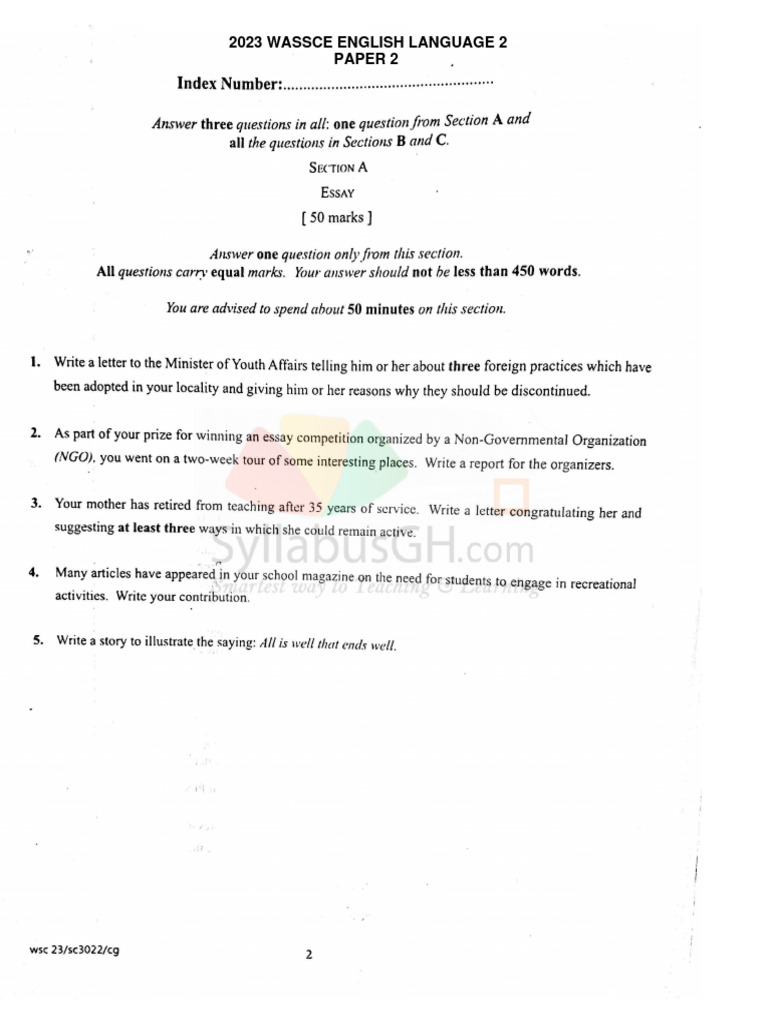
In a world where education is a pivotal pillar of development, examining the past can provide invaluable insights and guidance for the future. The West African Senior School Certificate Examination (WASSCE) for the year 2019 is a case in point. Specifically, the English Language paper offers a rich tapestry of questions that invite students to grapple with the nuances of the language while honing their analytical skills. With a blend of challenges and thought-provoking prompts, the 2019 English Language questions are not merely a test of knowledge but an invitation to explore the depths of linguistic artistry. In this article, we will delve into the various types of questions that were posed, their intended outcomes, and how they can serve as a springboard for deeper learning.
1. Understanding the Format of WASSCE English Language Questions
Before we plunge into the specific questions, it is imperative to grasp the overarching structure of the WASSCE English Language examination. Typically, this paper encompasses a variety of sections, including comprehension, summary writing, essay writing, and grammar. Each section challenges students to demonstrate their proficiency in different aspects of the English language, thereby offering a multi-faceted evaluation of their capabilities.
2. Comprehension Passages and Their Implications
The comprehension section of the WASSCE seeks to assess a student’s ability to extract meaning from text, encouraging critical engagement with the material presented. In the 2019 paper, students encountered passages that were laden with thematic depth and socio-cultural significance. Questions stemming from these passages required not just recall but inference, prompting students to contemplate underlying meanings and implications.
Moreover, comprehension exercises often compel students to analyze the author’s tone and intent, skills that are crucial in understanding nuanced communication. These experiences nurture a habit of critical reading—an indispensable trait for any informed citizen in today’s fast-paced world.
3. Summary Writing: The Art of Conciseness
The summary writing component demands brevity without sacrificing substance. In 2019, students were tasked with distilling complex ideas into coherent summaries that captured the essence of longer texts. This exercise cultivates the ability to synthesize information while fostering the capacity for critical judgment in determining relevance—a vital skill not only in academia but also in professional contexts.
A good summary does more than condense; it serves as a reflective exercise, forcing students to confront their own interpretations and biases. It teaches them to filter information and focus on what truly matters, a skill that transcends the classroom.
4. The Creative Task: Essays and Expression
The essay writing section invites personal engagement with topics that often invite diverse perspectives. In the 2019 exam, students faced prompts that encouraged them to articulate their viewpoints on contemporary social issues, such as the impact of technology on education, the significance of environmental conservation, and the value of cultural heritage.
Essay writing fosters an imaginative engagement with language, allowing students to express their unique voices. Additionally, it sharpens their ability to construct logical arguments, sequence ideas coherently, and employ varied vocabulary and syntax. Such skills are not merely academic; they equip students for the complexities of real-world discourse.
5. Grammar and Language Structure
The grammar section serves as a foundation for effective communication. In 2019, questions emphasized the importance of mastering sentence structure, punctuation, and syntax. Mastering these elements is crucial for articulating thoughts clearly and persuasively. The intricacies of grammar—often viewed as pedantic—are, in fact, the bedrock upon which eloquent expression is built. By reinforcing these principles, WASSCE empowers students to wield language as a tool of influence.
Moreover, grappling with grammatical challenges fosters resilience. Navigating Linguistic complexities sharpens analytical thinking, urging students to problem-solve and apply learned rules in innovative ways.
6. The Role of Feedback: Learning Beyond the Exam
As illuminating as the examination may be, the true learning occurs post-exam through feedback. Instructors play an essential role in guiding students in understanding their strengths and areas needing improvement. Analyzing performance on the 2019 questions facilitates a focus on individualized growth, ensuring that students are not merely recipients of knowledge but active participants in their educational journeys.
This reflective practice nurtures a mindset of continual improvement and lifelong learning. In an ever-evolving world, such adaptability opens doors to a wealth of opportunities.
7. Using Past Questions as a Study Tool
Reflecting on previous exams, particularly the questions from 2019, can be a fortifying strategy for students intent on mastering English. These questions are more than mere relics; they are keys to understanding exam expectations and gaining insights into successful communication styles. Engaging with these past questions fosters familiarity with the examination format, enabling students to approach assessments with greater confidence and competence.
Furthermore, the analysis of previous years’ questions can reveal emerging trends and shifts in educational priorities, thereby informing students’ study strategies.
Conclusion: A Catalyst for Growth and Exploration
The WASSCE English Language questions from 2019 serve as a profound reminder of the beauty and complexity of language. Each component of the exam—from comprehension to essay writing—invites students to explore their creativity, sharpen their analytical abilities, and cultivate a lifelong love for linguistic expression. As educators and students alike reflect on these questions, they are not just reviewing a test; they are engaging in a dynamic process of growth and exploration. By embracing the lessons contained within, the journey toward mastery of the English language can be a fulfilling and transformative experience.








Leave a Comment